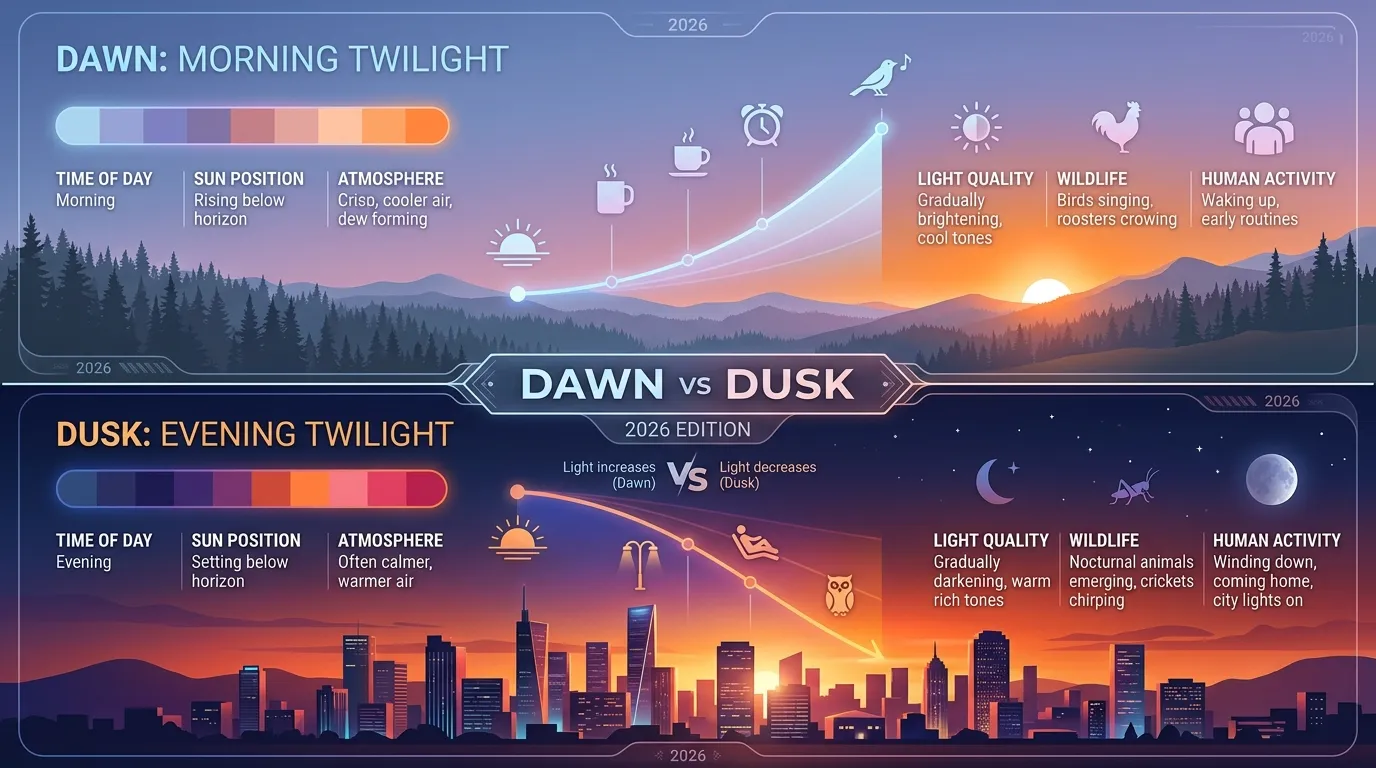
One day, Ali woke up very early. He looked outside and saw a soft light in the sky. Later that evening, he saw a similar soft light before night came. He wondered if both times had the same name.
Many people ask about the difference between dusk and dawn. The words sound simple, but they can be confusing. The difference between dusk and dawn is important because both describe times of day when the sky changes color.
These words are common in books, weather reports, travel guides, and daily conversations. If you know their meanings, you can use them correctly and understand English more easily.
In this guide, you will learn what dusk and dawn mean, how they differ, and when to use each one.
What is “Dusk”?
Dusk is the time just before night.
The sun has already gone below the horizon. The sky is becoming darker, but some light is still visible.
People often see dusk in the evening.
History of Dusk
The word “dusk” comes from very old English words that meant dark or shadowy. People used the word to describe the time when daylight slowly disappeared. Long ago, people depended on sunlight because they had no electric lights. Dusk was an important time because it signaled the end of the day’s work. Farmers, travelers, and families often returned home at dusk. Today, the word still means the period between sunset and night. It is often used in books, poems, and everyday speech to describe the fading light of evening.
What is “Dawn”?
Dawn is the time just before sunrise.
The sky starts getting brighter, but the sun has not fully appeared yet.
People see dawn in the morning.
History of Dawn
The word “dawn” comes from old Germanic and English words that meant the first appearance of daylight. For many centuries, dawn marked the start of a new day. People woke up at dawn to work, travel, or begin daily tasks. In many cultures, dawn became a symbol of hope and new beginnings. Writers and poets often used dawn to describe fresh starts and positive change. Today, dawn still refers to the early morning light that appears before the sun rises above the horizon.
Dusk vs Dawn
Dusk: The fading light before night.
Dawn: The first light before sunrise.
One happens at the end of the day. The other happens at the beginning. Let’s look at the differences in more detail.
How Dusk Works
Dusk appears after sunset.
Key Features
- Happens in the evening
- Comes before night
- The sky gets darker
- Marks the end of daylight
- Often shows orange and purple colors
Examples
🔵 We went home at dusk.
🔵 Birds returned to their nests at dusk.
Uses
- Weather reports
- Travel guides
- Daily conversation
- Stories and poems
- Nature studies
How Dawn Works
Dawn appears before sunrise.
Key Features
- Happens in the morning
- Comes before sunrise
- The sky gets brighter
- Marks the start of daylight
- Often shows pink and golden colors
Examples
🟢 We started our trip at dawn.
🟢 The farmers began work at dawn.
Uses
- Weather reports
- Morning schedules
- Literature
- Travel planning
- Outdoor activities
Which One Should You Use?
Use dusk when talking about the evening before night.
Use dawn when talking about the morning before sunrise.
10 Differences Between Dusk and Dawn
1. Time of Day
Dusk: Happens in the evening.
🔴 We walked home at dusk.
🔴 The park closed at dusk.
Dawn: Happens in the morning.
🔴 We left at dawn.
🔴 The birds sang at dawn.
2. Position in the Day
Dusk: Near the end of the day.
🔴 Dusk comes after sunset.
🔴 Night follows dusk.
Dawn: Near the start of the day.
🔴 Dawn comes before sunrise.
🔴 Daylight follows dawn.
3. Light Direction
Dusk: Light is fading.
🔴 The sky became darker.
🔴 The light slowly disappeared.
Dawn: Light is increasing.
🔴 The sky became brighter.
🔴 Light slowly appeared.
4. Daily Meaning
Dusk: Signals day’s end.
🔴 Shops closed at dusk.
🔴 Workers went home at dusk.
Dawn: Signals day’s beginning.
🔴 People woke up at dawn.
🔴 The city came alive at dawn.
5. Sky Appearance
Dusk: Dark colors often appear.
🔴 Purple clouds filled the sky.
🔴 The sky turned deep orange.
Dawn: Lighter colors often appear.
🔴 Pink clouds filled the sky.
🔴 The sky glowed softly.
6. Activities
Dusk: People often finish activities.
🔴 Children stopped playing.
🔴 Farmers ended work.
Dawn: People often begin activities.
🔴 Joggers started running.
🔴 Farmers began work.
7. Temperature
Dusk: Air may cool down.
🔴 The evening became cooler.
🔴 A cool breeze arrived.
Dawn: Air is often cool already.
🔴 The morning felt fresh.
🔴 The grass was wet with dew.
8. Symbolism
Dusk: Often means endings.
🔴 The story ended at dusk.
🔴 Dusk marked the final chapter.
Dawn: Often means beginnings.
🔴 Dawn brought new hope.
🔴 Dawn marked a fresh start.
9. Sleep Patterns
Dusk: Many people prepare to rest.
🔴 We ate dinner at dusk.
🔴 We relaxed after dusk.
Dawn: Many people wake up.
🔴 He woke at dawn.
🔴 She started work at dawn.
10. Relation to the Sun
Dusk: Comes after sunset.
🔴 The sun had already set.
🔴 Dusk arrived quickly.
Dawn: Comes before sunrise.
🔴 The sun had not risen yet.
🔴 Dawn came before sunrise.
Why People Get Confused About Their Use
People confuse dusk and dawn because both happen when the sky is not fully bright or fully dark. Both show beautiful colors. Both occur during a change in light. The main difference is simple: dawn is in the morning, while dusk is in the evening.
Table: Difference and Similarity
| Feature | Dusk | Dawn | Similarity |
|---|---|---|---|
| Time | Evening | Morning | Both are times of changing light |
| Comes Before | Night | Sunrise | Both occur daily |
| Light | Fading | Increasing | Both have soft light |
| Meaning | End of day | Start of day | Both relate to the sun |
| Common Use | Evening events | Morning events | Both appear in literature |
Which is Better in What Situation?
Dusk is better when talking about the evening. It helps describe the end of the day. People often use it in stories, weather reports, and travel plans.
Dawn is better when talking about the morning. It helps describe a fresh start. People often use it when discussing early work, exercise, travel, or nature.
How Are “Dusk” and “Dawn” Used in Metaphors and Similes?
🟣 “The company was at dusk” means it was nearing its end.
🟣 “A new dawn arrived” means a new beginning started.
🟣 “Hope rose like dawn” means hope appeared slowly.
🟣 “His career reached dusk” means his career was ending.
Connotative Meaning
Dusk
🟣 Positive: Peaceful evening
🟣 Neutral: End of daylight
🟣 Negative: Ending or decline
Example:
🟣 The village looked peaceful at dusk.
Dawn
🟣 Positive: Hope and new beginnings
🟣 Neutral: Early morning
🟣 Negative: Very early wake-up time
Example:
🟣 Dawn brought new opportunities.
Idioms or Proverbs
🟣 “From dawn till dusk”
Meaning: All day long.
Example: He worked from dawn till dusk.
🟣 “A new dawn”
Meaning: A fresh beginning.
Example: The agreement marked a new dawn for the town.
Works in Literature
🟣 Dawn by Elie Wiesel (1961)
🟣 Dusk by Saki (1914)
🟣 Dawn at Puri by Jayanta Mahapatra (1976)
🟣 Dusk by D. H. Lawrence (1916)
Movies Related to the Keywords
🟣 From Dusk Till Dawn (1996, United States)
🟣 Dawn of the Dead (1978, United States)
🟣 Dawn of the Planet of the Apes (2014, United States)
🟣 Dusk (2008, Hungary)
Possible Questions
1. What is the main difference between dusk and dawn?
Dusk happens before night. Dawn happens before sunrise.
2. Is dusk in the morning?
No. Dusk is in the evening.
3. Is dawn before sunrise?
Yes. Dawn comes before sunrise.
4. Which comes first, dawn or sunrise?
Dawn comes first.
5. What comes after dusk?
Night comes after dusk.
Final Words
Learning new words becomes easier when you connect them to daily life. Think of dawn as the start of the day and dusk as the end. This simple idea can help you remember them forever.
Conclusion
The difference between dusk and dawn is easy to understand once you know when each one happens. Dawn is the early morning light before sunrise. Dusk is the evening light after sunset. Dawn marks the beginning of the day, while dusk marks the end. Both are beautiful times when the sky changes color and light. They are common in everyday speech, books, weather reports, and travel writing. If you remember that dawn comes before sunrise and dusk comes before night, you will always use these words correctly.

I’m Zahid Abbas, an educator, researcher, and digital publishing strategist with a passion for linguistics, grammar, and clear communication. As a content creator and SEO specialist, I craft research-driven, reader-focused content that empowers learners and makes knowledge accessible worldwide.