Imagine you are driving home after work. A police officer stops your car because you were driving a little faster than the speed limit. The officer hands you a piece of paper. Your friend later asks, “Did you get a ticket or a citation?” You may wonder if there is any difference.
Many people search for the difference between ticket and citation because the two terms are often used together. The difference between ticket and citation can be confusing, especially for beginners, students, and English learners. In many everyday conversations, people use them as if they mean the same thing. However, in legal situations, there is a small but important difference.
This guide explains what each term means, how they are used, and when you should use one instead of the other.
What Is a Ticket?
A ticket is a common word for an official notice given by a police officer when someone breaks a traffic or parking rule. It usually tells the driver what law was broken, the amount of the fine, and what to do next.
History of the Word “Ticket”
The word ticket comes from the Old French word etiquette, which meant a small written note or label. Over time, it became the English word for many kinds of printed slips, such as train tickets, movie tickets, and traffic tickets. Today, it is the word most people use when talking about traffic violations.
What Is a Citation?
A citation is the official legal document that records a traffic or other law violation. Police officers and courts often use this term in official reports.
History of the Word “Citation”
The word citation comes from the Latin word citare, meaning “to summon” or “to call.” It was first used in legal settings to describe an order to appear before a court. Today, it is commonly used for official notices issued after someone breaks a law.
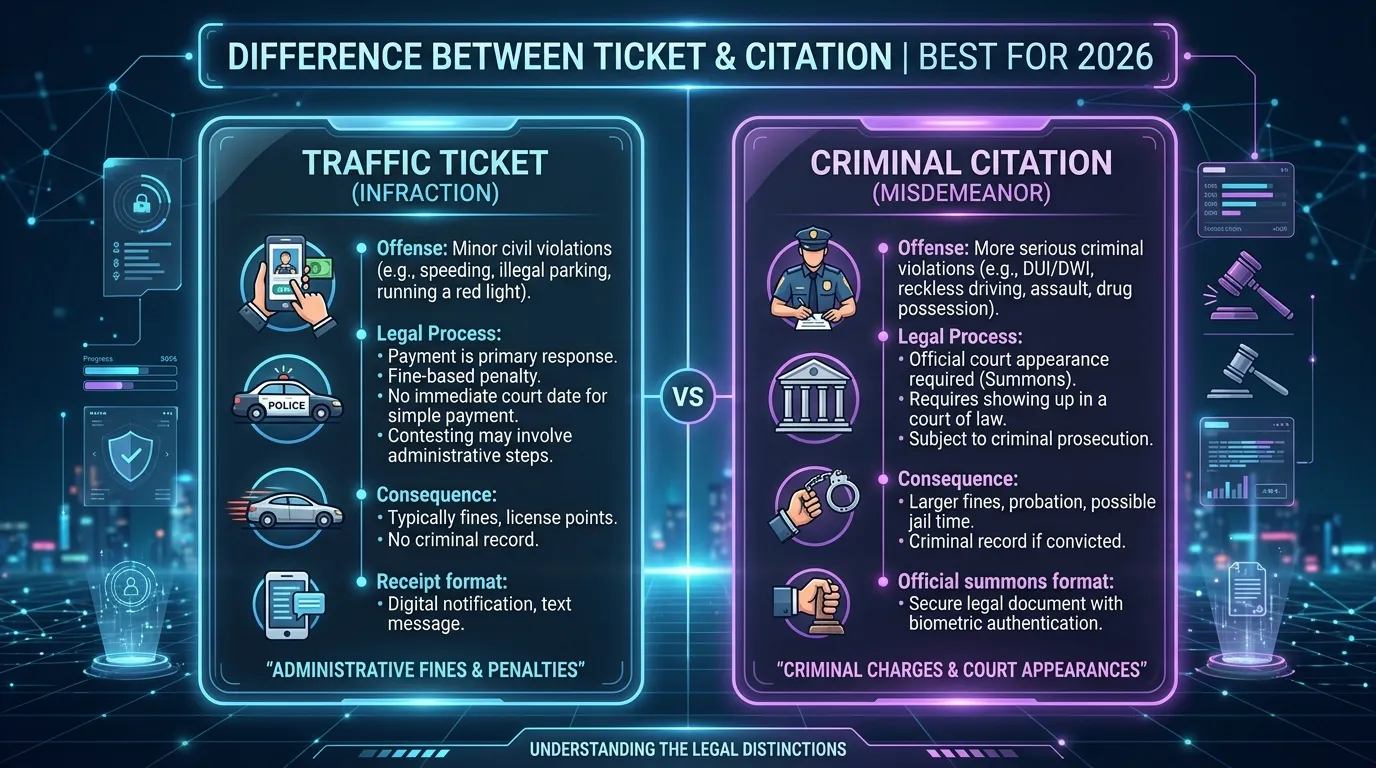
Ticket vs Citation
Ticket: The everyday word for a notice given after breaking a traffic rule.
Citation: The formal legal name for that official notice.
In many traffic cases, both words refer to the same document. The difference is mainly the level of formality.
How Ticket Works
When a police officer believes a driver has broken a traffic law, they may issue a ticket.
Key Features
- Easy-to-understand everyday term
- Usually given for traffic or parking violations
- May include a fine or court date
- Common in daily conversation
Examples
🔵 The officer gave me a speeding ticket.
🔵 She paid her parking ticket online.
Common Uses
- Daily conversation
- Driving situations
- News reports
- Informal writing
How Citation Works
A citation is the official legal record of a violation. It contains details about the incident and explains what the person must do next.
Key Features
- Formal legal document
- Used by police and courts
- Includes details of the alleged offense
- May require a court appearance
Examples
🟢 The officer issued a citation for running a red light.
🟢 The judge reviewed the traffic citation.
Common Uses
- Police reports
- Court documents
- Legal writing
- Government records
Which One Should You Use?
Use ticket when speaking with friends or family.
Use citation when discussing legal matters or official documents.
10 Differences Between Ticket and Citation
1. Meaning
Ticket: A common name for a traffic violation notice.
🔴 He received a speeding ticket.
🔴 She paid her parking ticket.
Citation: The official legal notice.
🔴 The officer wrote a citation.
🔴 The citation included the law that was broken.
2. Formality
Ticket: Informal and commonly used.
🔴 I got a ticket today.
🔴 Nobody likes getting tickets.
Citation: Formal and legal.
🔴 The citation was filed in court.
🔴 His lawyer reviewed the citation.
3. Common Users
Ticket: Used by the public.
🔴 My brother got a ticket.
🔴 She worries about parking tickets.
Citation: Used by police and legal professionals.
🔴 The officer completed the citation.
🔴 The attorney explained the citation.
4. Purpose
Ticket: Informs someone about a traffic violation.
🔴 The ticket showed the fine.
🔴 The ticket listed the due date.
Citation: Officially records the violation.
🔴 The citation became part of the legal record.
🔴 The court accepted the citation.
5. Language
Ticket: Everyday English.
🔴 I received a ticket yesterday.
🔴 Did you pay your ticket?
Citation: Legal English.
🔴 The citation requires a response.
🔴 He challenged the citation.
6. Documents
Ticket: Usually refers to the paper handed to the driver.
🔴 Keep your ticket safe.
🔴 I lost my parking ticket.
Citation: Refers to the official legal record.
🔴 The citation was entered into the database.
🔴 Each citation has a case number.
7. Audience
Ticket: General public.
🔴 Everyone understands the word ticket.
🔴 The news reported many parking tickets.
Citation: Legal professionals.
🔴 The citation was reviewed by the judge.
🔴 Police officers complete citations daily.
8. Context
Ticket: Everyday conversations.
🔴 He got a ticket on his way home.
🔴 She complained about the ticket.
Citation: Official discussions.
🔴 The citation was dismissed.
🔴 The citation included all the evidence.
9. Tone
Ticket: Friendly and informal.
🔴 I hope I don’t get another ticket.
🔴 Parking tickets are expensive.
Citation: Serious and official.
🔴 The citation remains on record.
🔴 The officer explained the citation.
10. Main Focus
Ticket: What happened to the driver.
🔴 She received a ticket.
🔴 He paid the ticket.
Citation: The legal process.
🔴 The citation started the court case.
🔴 The citation documented the violation.
Why People Get Confused
People often confuse these words because they usually describe the same event. A police officer may issue one document, but drivers call it a ticket, while police officers may call it a citation. The meaning changes more by context than by the document itself.
Difference and Similarity Table
| Feature | Ticket | Citation | Similarity |
|---|---|---|---|
| Meaning | Common term | Legal term | Both relate to violations |
| Formality | Informal | Formal | Both describe official notices |
| Users | Public | Police and courts | Both are widely understood |
| Purpose | Notify driver | Record violation | Both explain the offense |
| Example | Speeding ticket | Traffic citation | Same event |
Which Is Better in What Situation?
Use ticket in daily conversation because it sounds natural and is easy for everyone to understand. Most native English speakers say, “I got a speeding ticket,” instead of “I received a citation.”
Use citation when talking about legal matters, police reports, or court cases. It is the correct term for official documents and professional communication.
How Are “Ticket” and “Citation” Used in Metaphors and Similes?
🟣 “A ticket to success” means an opportunity to succeed.
🟣 “A citation of honor” can describe official recognition or praise.
Connotative Meaning
Ticket
🟣 Usually neutral but often negative when it means a traffic fine.
Citation
🟣 Neutral in legal writing and positive when it refers to an academic citation or an award citation.
Idioms or Common Expressions
🟣 A ticket to freedom – A chance to become free.
Example: Education is a ticket to a better future.
🟣 Write someone a ticket – Give an official traffic violation notice.
Example: The officer wrote him a ticket for speeding.
Works in Literature
🟣 The Trial by Franz Kafka (1925) explores legal systems and official notices.
🟣 To Kill a Mockingbird by Harper Lee (1960) includes courtroom and legal procedures where official documents are important.
Movies Related to the Keywords
🟣 Traffic (2000, USA)
🟣 Crash (2004, USA)
Both films involve police work, law enforcement, and legal procedures.
Possible Questions
1. Is a ticket the same as a citation?
Almost. A ticket is the everyday word, while citation is the formal legal term.
2. Which word is more common?
Ticket is more common in daily conversation.
3. Do police officers use the word citation?
Yes. Police reports and courts usually use citation.
4. Can I use ticket in legal writing?
It is better to use citation in formal legal documents.
5. Which word should English learners use?
Use ticket in normal conversation and citation in official or legal contexts.
Final Words
Learning the difference between these two words is easier than it first seems. Once you understand when people use ticket and when they use citation, you can speak and write with more confidence. Practice using both words in real-life situations, and soon the difference will feel natural.
Conclusion
The difference between ticket and citation is mainly about formality. A ticket is the everyday word people use for a traffic violation notice, while a citation is the official legal term used by police officers and courts. In many situations, both words refer to the same document, but the context determines which one sounds more natural. Use ticket in daily conversations and citation in legal or official settings. Understanding this small difference will help you communicate more clearly and avoid confusion when discussing traffic laws or legal documents.

I’m Zahid Abbas, an educator, researcher, and digital publishing strategist with a passion for linguistics, grammar, and clear communication. As a content creator and SEO specialist, I craft research-driven, reader-focused content that empowers learners and makes knowledge accessible worldwide.










