Mary’s father had a stroke. After that, he had trouble speaking. One doctor said he had aphasia. Another doctor said he had dysphasia.
Mary became confused.
Many people do.
The difference between aphasia and dysphasia can be hard to understand. Both words talk about language problems. Both can affect speaking and understanding. Because of this, many people think they mean different diseases.
The truth is simpler.
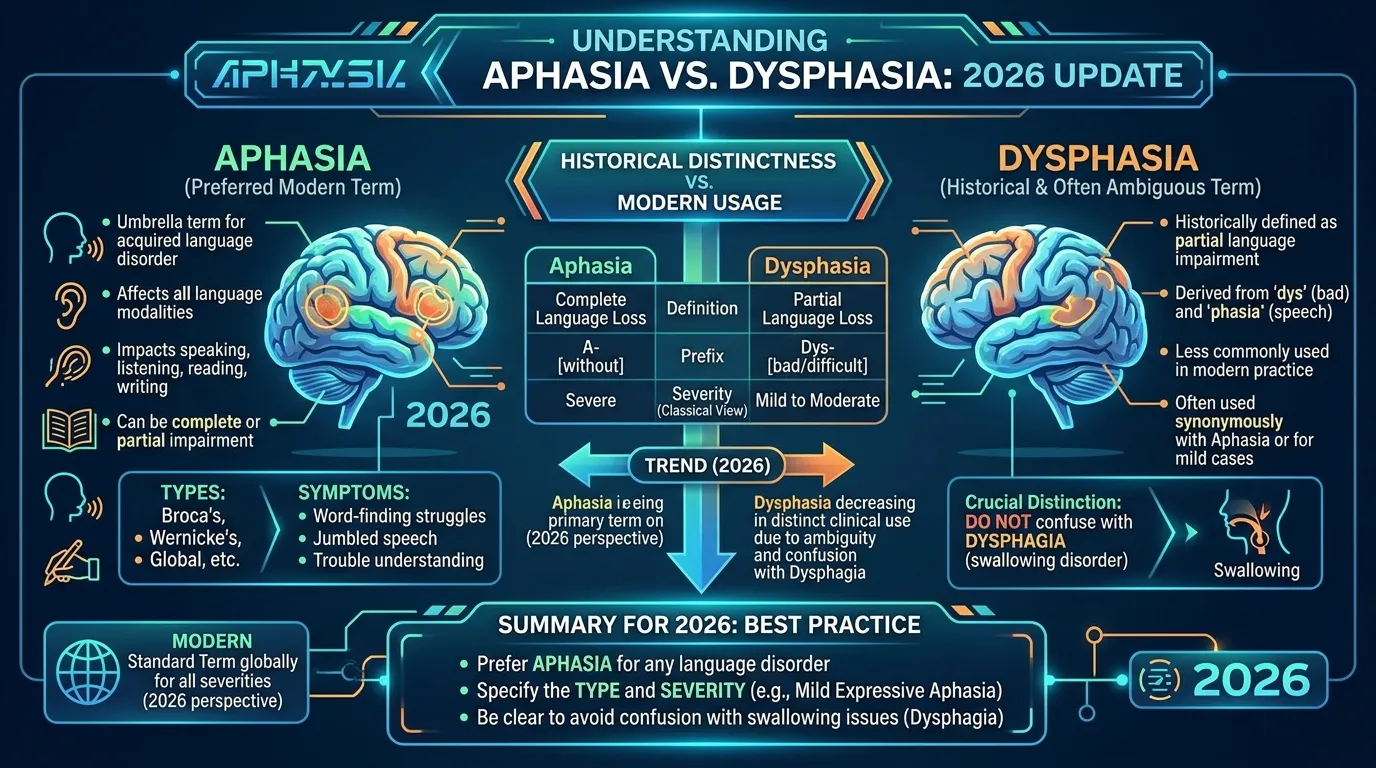
The difference between aphasia and dysphasia is mostly about how doctors use the words. Today, many doctors use the word “aphasia” for all types of language problems after brain damage.
Knowing these terms can help patients, families, and students understand medical reports better.
In this guide, you will learn the meaning of both words and see how they are different.
What Is “Aphasia”?
Aphasia is a language disorder. It makes speaking, reading, writing, or understanding words hard. It often happens after a stroke or brain injury.
What Is “Dysphasia”?
Dysphasia is also a language disorder. It means a person has trouble with language. In the past, doctors often used it for a partial loss of language.
History of Aphasia
The word aphasia comes from Greek. It means “without speech.” Doctors have used this term for more than one hundred years. In the 1800s, doctors learned that damage to certain parts of the brain could affect language. They used the word aphasia to describe these problems. Today, doctors around the world use aphasia for mild, moderate, and severe language disorders. It is now the most common term.
History of Dysphasia
The word dysphasia also comes from Greek. The part “dys” means difficult. Doctors once used dysphasia to describe partial language loss. They used aphasia for complete loss. Over time, this difference became less important. Many doctors now use aphasia for both conditions. Still, some hospitals and countries continue to use dysphasia.
Aphasia vs Dysphasia
Aphasia means a language disorder caused by brain damage.
Dysphasia means difficulty with language.
In modern medicine, the two words often mean the same thing.
Let us look at them in more detail.
How Aphasia Works
Key Features
- Affects language
- May affect speaking
- May affect reading
- May affect writing
- Often caused by stroke
🔵 He knew what he wanted to say but could not find the words.
🔵 She had trouble understanding simple questions.
Uses
- Hospitals
- Speech therapy
- Brain injury care
- Daily communication
How Dysphasia Works
Key Features
- Causes language problems
- May be mild or severe
- Can affect speaking and understanding
- Often linked to brain injury
🟢 The patient had trouble making sentences.
🟢 He understood words but could not say them clearly.
Uses
- Medical reports
- Speech therapy
- Brain rehabilitation
Which One Should You Use?
Today, most doctors prefer the word aphasia.
Some doctors still use dysphasia.
In many cases, both words mean the same thing.
10 Differences Between Aphasia and Dysphasia
1. Common Use
Aphasia is more common today.
🔴 The doctor diagnosed aphasia.
🔴 She attends aphasia therapy.
Dysphasia is used less often.
🔴 An old report used dysphasia.
🔴 Some doctors still use the word.
2. Meaning
Aphasia may describe any level of language loss.
🔴 He had aphasia after a stroke.
🔴 She could not understand long sentences.
Dysphasia often means partial language loss.
🔴 His speech problem was mild.
🔴 She could still speak a little.
3. Popularity
Aphasia is used around the world.
🔴 Most hospitals use aphasia.
🔴 Medical books use aphasia.
Dysphasia is less common.
🔴 Some countries still use it.
🔴 Older books mention dysphasia.
4. Modern Medicine
Aphasia is preferred today.
🔴 Doctors use aphasia.
🔴 Research papers use aphasia.
Dysphasia is less popular.
🔴 Some experts still use it.
🔴 Some reports mention it.
5. Severity
Aphasia can be mild or severe.
🔴 Mild aphasia affects speaking.
🔴 Severe aphasia affects reading and writing.
Dysphasia often means a milder problem.
🔴 He could speak short sentences.
🔴 She understood simple words.
6. Medical Reports
Aphasia appears more often.
🔴 The report mentioned aphasia.
🔴 The nurse explained aphasia.
Dysphasia appears less often.
🔴 An older report used dysphasia.
🔴 Some clinics still use it.
7. Therapy
Speech therapists usually say aphasia.
🔴 Therapy improved her aphasia.
🔴 He practiced language exercises.
Some therapists use dysphasia.
🔴 The therapist treated dysphasia.
🔴 Progress became better.
8. Learning Resources
Most websites use aphasia.
🔴 Articles explain aphasia.
🔴 Videos discuss aphasia.
Some books use dysphasia.
🔴 Old papers mention dysphasia.
🔴 Older guides use the term.
9. Global Use
Aphasia is accepted worldwide.
🔴 Hospitals use aphasia.
🔴 Universities teach aphasia.
Dysphasia is common in fewer places.
🔴 Some doctors prefer dysphasia.
🔴 Some schools teach both words.
10. Current Preference
Aphasia is the modern choice.
🔴 Most specialists say aphasia.
🔴 New studies use aphasia.
Dysphasia is older.
🔴 Older doctors may say dysphasia.
🔴 Some countries still use it.
Why People Get Confused About Their Use
People get confused because both words describe language problems. They also have similar meanings. In some countries, doctors use both terms. This makes many people think they are different diseases. In fact, they often describe the same condition.
Table: Difference and Similarity
| Feature | Aphasia | Dysphasia | Similarity |
|---|---|---|---|
| Meaning | Language disorder | Language disorder | Both affect language |
| Cause | Brain damage | Brain damage | Same causes |
| Speaking | Difficult | Difficult | Both affect speech |
| Reading | May be affected | May be affected | Similar problems |
| Writing | May be affected | May be affected | Both can affect writing |
| Modern use | Common | Less common | Both are medical terms |
| Treatment | Speech therapy | Speech therapy | Same treatment |
Which Is Better in What Situation?
Today, aphasia is usually the better word. Most doctors, books, and websites use it. If you read medical articles, you will often see aphasia.
Dysphasia is still correct. Some doctors and hospitals use it. If your doctor says dysphasia, do not worry. In many cases, it means the same thing as aphasia.
How Are “Aphasia” and “Dysphasia” Used in Metaphors and Similes?
🟣 Aphasia can feel like a locked door between thoughts and words.
🟣 Dysphasia is like trying to finish a puzzle with missing pieces.
🟣 Speaking with aphasia may feel like searching in the dark.
Connotative Meaning
Both words are neutral medical terms.
🟣 Aphasia has a neutral meaning.
🟣 Dysphasia has a neutral meaning.
🟣 Neither word is positive or negative.
Idioms or Proverbs
These words do not appear in common idioms.
Still, people may say:
🟣 “Lost for words.”
Meaning: Unable to speak.
Example: After the stroke, he was lost for words.
Works in Literature
🟣 The Diving Bell and the Butterfly by Jean-Dominique Bauby, 1997.
🟣 My Stroke of Insight by Jill Bolte Taylor, 2006.
Movies Related to the Keywords
🟣 The Diving Bell and the Butterfly, 2007, France.
🟣 Regarding Henry, 1991, United States.
Frequently Asked Questions
1. Are aphasia and dysphasia the same?
Often, yes. Many doctors use the words in the same way.
2. Which term is more common?
Aphasia is more common today.
3. Can a stroke cause aphasia?
Yes. Stroke is one of the main causes.
4. Is dysphasia permanent?
Not always. Some people improve with therapy.
5. What treatment helps?
Speech and language therapy can help many people.
Final Words
Learning these terms may seem hard at first. But the basic idea is simple. Both words describe problems with language after brain damage. Understanding them can help patients and families feel more confident.
Conclusion
The difference between aphasia and dysphasia is smaller than many people think. Both words describe problems with language. In the past, doctors used dysphasia for partial language loss and aphasia for complete loss. Today, most doctors use aphasia for all levels of language problems. That is why aphasia is more common in hospitals and medical books. If you hear either word, remember that they often mean the same thing. Understanding the difference between aphasia and dysphasia can make medical reports easier to understand and help families communicate better with doctors and therapists.

I’m Zahid Abbas, an educator, researcher, and digital publishing strategist with a passion for linguistics, grammar, and clear communication. As a content creator and SEO specialist, I craft research-driven, reader-focused content that empowers learners and makes knowledge accessible worldwide.