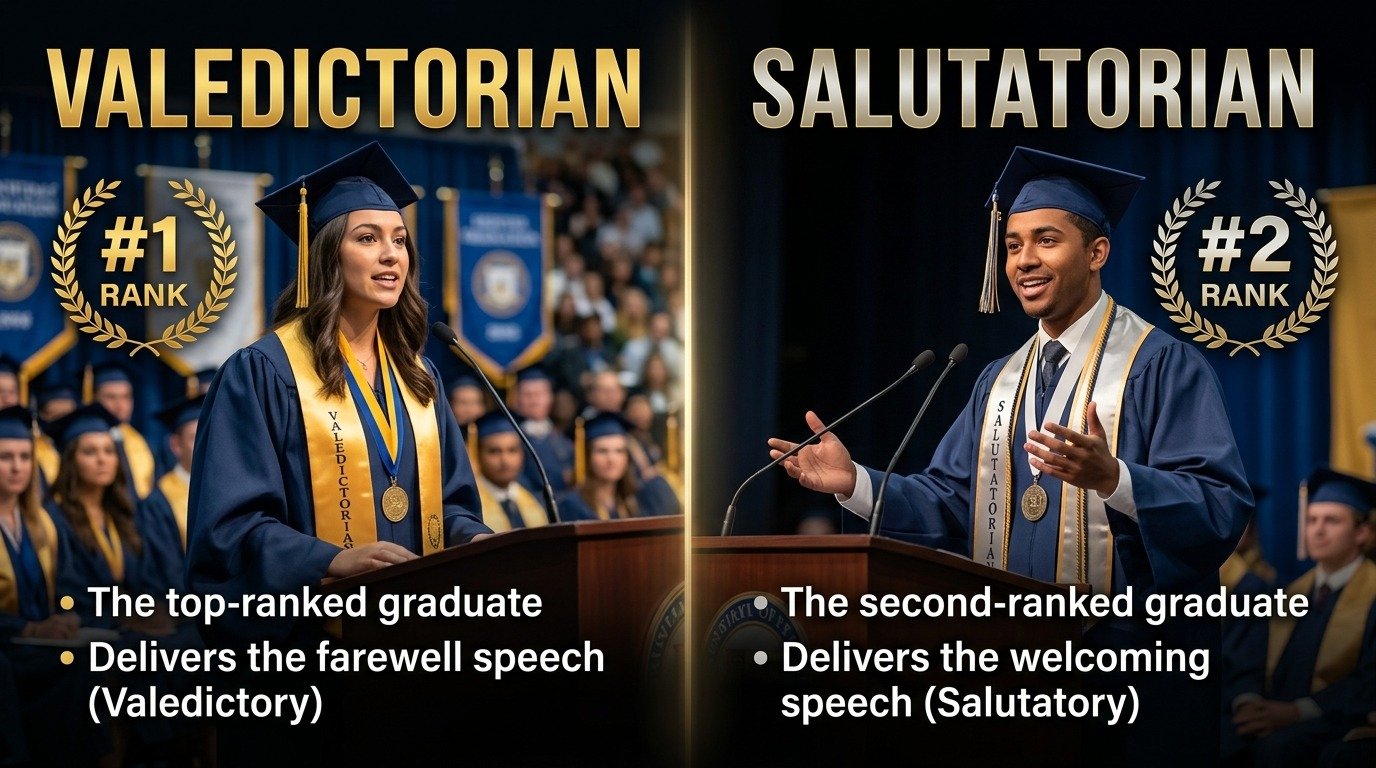
Imagine a high school graduation day. The students are wearing gowns, families are taking photos, and the school is ready to celebrate. Two students receive special honors. The first student has the highest academic record and gives the main farewell speech. This student is the valedictorian. The second student has the next-highest academic record and often gives the welcome speech. This student is the salutatorian. Understanding the difference between valedictorian and salutatorian helps students understand how academic honors work. The difference between valedictorian and salutatorian is mainly about class rank and the role at graduation. Knowing the difference between valedictorian and salutatorian also helps parents, teachers, and learners use these words correctly. In this guide, we will explain the difference between valedictorian and salutatorian with simple examples.
Key Difference Between the Both
The main difference is rank and speech role. A valedictorian is usually the student with the highest academic rank. A salutatorian is usually the student with the second-highest academic rank. The valedictorian traditionally gives the valedictory, or farewell, speech. The salutatorian traditionally gives the salutatory, or greeting, speech. (Cambridge Dictionary)
Why Is Their Difference Necessary to Know for Learners and Experts?
These words are important in education. Students may see them on graduation programs, school websites, certificates, and college news. Teachers and parents also use them when talking about academic success. Knowing the difference prevents mistakes and helps people understand school honors clearly.
The titles can also show hard work, strong study habits, and leadership. However, schools may use different rules for choosing these students. Some schools may have more than one valedictorian or may use another system for academic honors.
Pronunciation of Valedictorian and Salutatorian
According to Cambridge, the US pronunciation of valedictorian is /ˌvæl.ə.dɪkˈtɔːr.i.ən/, while the UK pronunciation is /ˌvæl.ə.dɪkˈtɔː.ri.ən/. (Cambridge Dictionary)
For salutatorian, the US pronunciation is /səˌluː.təˈtɔːr.i.ən/, while the UK pronunciation is /səˌljuː.təˈtɔː.ri.ən/. (Cambridge Dictionary)
Now that the basic meaning is clear, let us look at the differences one by one.
Difference Between the Keywords
1. Academic Rank
Valedictorian:
The valedictorian is usually ranked first in the graduating class.
Example 1: Maria became valedictorian after earning the highest GPA in her class.
Example 2: The school announced James as its valedictorian.
Salutatorian:
The salutatorian is usually ranked second in the graduating class.
Example 1: Sara became salutatorian with the second-highest GPA.
Example 2: The school honored David as its salutatorian.
2. Position in the Class
Valedictorian:
The valedictorian normally holds the top academic position.
Example 1: Emma finished first and became valedictorian.
Example 2: The valedictorian had the highest final grades.
Salutatorian:
The salutatorian normally holds the second academic position.
Example 1: Noah finished second and became salutatorian.
Example 2: The salutatorian was very close to the top student in grades.
3. Graduation Speech
Valedictorian:
The valedictorian traditionally gives a farewell speech. This speech is called a valedictory address.
Example 1: The valedictorian thanked the teachers in her speech.
Example 2: The valedictorian gave advice to the graduating class.
Salutatorian:
The salutatorian traditionally gives a greeting or opening speech. This is called a salutatory address.
Example 1: The salutatorian welcomed the guests.
Example 2: The salutatorian opened the graduation program with a short speech.
4. Meaning of the Words
Valedictorian:
The word is linked to the idea of saying farewell. This fits the farewell speech given at graduation.
Example 1: The valedictorian gave a farewell message to classmates.
Example 2: Her valedictorian speech looked back at school memories.
Salutatorian:
The word is linked to a greeting or welcome.
Example 1: The salutatorian welcomed parents to the ceremony.
Example 2: His salutatorian speech greeted everyone at graduation.
5. Main Academic Honor
Valedictorian:
This title normally represents the highest academic honor in the graduating class.
Example 1: Winning valedictorian was a proud moment for Lina.
Example 2: The school gave the valedictorian a special place in the ceremony.
Salutatorian:
This title normally represents the second-highest academic honor.
Example 1: Being salutatorian was a major achievement for Omar.
Example 2: The school praised the salutatorian for excellent grades.
6. Relationship With GPA
Valedictorian:
In schools that use GPA for ranking, the valedictorian usually has the highest GPA.
Example 1: A 4.0 GPA helped Anna become valedictorian.
Example 2: The student with the highest qualifying GPA became valedictorian.
Salutatorian:
The salutatorian usually has the second-highest qualifying GPA.
Example 1: Ben had the second-highest GPA and became salutatorian.
Example 2: The school used GPA to choose its salutatorian.
Note: Schools can have different ranking rules.
7. Level of Competition
Valedictorian:
The student normally finishes at the top of a close academic competition.
Example 1: Two students competed closely for valedictorian.
Example 2: A small grade difference decided the valedictorian position.
Salutatorian:
The student normally finishes just behind the top-ranked student.
Example 1: Mia missed first place by a small margin and became salutatorian.
Example 2: The salutatorian had almost the same GPA as the valedictorian.
8. School Recognition
Valedictorian:
Schools often give the valedictorian special recognition during graduation.
Example 1: The principal introduced the valedictorian before the speech.
Example 2: The valedictorian’s name appeared first on the honors list.
Salutatorian:
The salutatorian also receives important recognition.
Example 1: The principal introduced the salutatorian after the valedictorian.
Example 2: The school placed the salutatorian’s name on the graduation program.
9. Leadership at Graduation
Valedictorian:
The valedictorian often represents the graduating class through a final message.
Example 1: The valedictorian spoke about the class’s shared journey.
Example 2: The valedictorian encouraged classmates to follow their dreams.
Salutatorian:
The salutatorian often helps begin the formal part of the ceremony.
Example 1: The salutatorian welcomed families and teachers.
Example 2: The salutatorian gave the opening message.
10. Use in Everyday English
Valedictorian:
This word is mainly used in American education. It refers to a high-ranking graduating student.
Example 1: My sister was valedictorian of her high school class.
Example 2: The newspaper interviewed the school’s valedictorian.
Salutatorian:
This word is also mainly used in the American education system.
Example 1: The newspaper interviewed the new salutatorian.
Example 2: Her college application mentioned that she was salutatorian.
Nature and Behaviour of Valedictorian
A valedictorian is connected with first place, academic success, and farewell. The word usually describes a student who has worked very hard over a long period.
The title can also suggest discipline and strong study habits. However, being valedictorian does not mean that the student is better than every other person in every area. It mainly describes academic rank under a school’s rules.
also read more abouehttps://comparificationn.com/difference-between-investing-and-saving-10-key-differences/
Nature and Behaviour of Salutatorian
A salutatorian is connected with second place, academic success, and greeting. The student has usually achieved the second-highest academic rank.
A salutatorian can also show leadership and strong communication skills through the graduation speech. Being second does not mean being unsuccessful. It is a major academic honor.
Why Are People Confused About Their Use?
People often confuse these words because both describe top students at graduation. Both students usually have excellent grades. Both may speak during the graduation ceremony. Both titles also end with -torian, which makes them look and sound similar.
Another reason is that school rules can differ. Some schools use GPA. Others may use a different ranking system. Some schools may have co-valedictorians or may not name a salutatorian.
The easiest way to remember them is:
- Valedictorian = first
- Salutatorian = second
- Valedictorian = farewell
- Salutatorian = greeting
Difference and Similarity Between Valedictorian and Salutatorian
| Feature | Valedictorian | Salutatorian |
| Usual rank | First | Second |
| Academic record | Usually highest | Usually second highest |
| Main speech | Valedictory speech | Salutatory speech |
| Speech purpose | Farewell | Greeting |
| Graduation role | Often gives final student speech | Often gives opening student speech |
| Academic honor | Highest class honor | Second-highest class honor |
| Usually linked with | Farewell | Welcome |
| Used in education | Yes | Yes |
| Shows achievement | Yes | Yes |
| School rules | Can vary | Can vary |
| Similarity | Both are honored graduates | Both are honored graduates |
Which Is Better in What Situation?
When Is Valedictorian Better?
Valedictorian is the better term when you are talking about the student with the highest academic rank in the graduating class. It is also the right word when discussing the student who gives the traditional farewell speech. For example, you should say, “She was the valedictorian of her class,” when she finished first under her school’s ranking rules.
When Is Salutatorian Better?
Salutatorian is the better term when you are talking about the student with the second-highest academic rank. Use it when the student has earned the second position and is connected with the traditional greeting speech. For example, “He was the salutatorian of his graduating class” is correct when he finished second under the school’s rules.
Neither title is “better” in every sense. Valedictorian is higher in class rank, but salutatorian is also a major achievement.
How Are Valedictorian and Salutatorian Used in Metaphors and Similes?
These words can sometimes be used outside school as comparisons.
Valedictorian as a Metaphor
A person may be called the “valedictorian of the team” to suggest that the person is the best performer.
Example:
“After winning five awards, she became the valedictorian of the company.”
Here, the word does not mean a real graduating student. It means a top performer.
Salutatorian as a Metaphor
A person may be called the “salutatorian of the group” to suggest that the person is very strong but comes just behind the top person.
Example:
“He was the salutatorian of the research team, always finishing just behind the leader.”
Simile Examples
Example 1:
“She studied like a valedictorian preparing for graduation.”
Example 2:
“He stood beside the winner like a salutatorian beside the valedictorian.”
These are creative uses. The normal meanings remain connected to graduation and academic rank.
Connotative Meaning of Valedictorian and Salutatorian
Connotative Meaning of Valedictorian
Positive:
The word can suggest intelligence, hard work, discipline, success, and leadership.
Example:
“Her valedictorian honor showed years of careful study.”
Negative:
In some situations, the word may suggest pressure, perfectionism, or too much focus on grades.
Example:
“Being valedictorian brought so much pressure that he found it hard to relax.”
Neutral:
It can simply state a student’s academic position.
Example:
“David was the valedictorian of the class.”
Connotative Meaning of Salutatorian
Positive:
The word can suggest achievement, intelligence, effort, and strong academic performance.
Example:
“Her salutatorian award showed her great academic effort.”
Negative:
In some contexts, it may create a feeling of being second-best.
Example:
“He was proud of being salutatorian but felt sad about missing first place.”
Neutral:
It can simply describe the student’s academic rank.
Example:
“Maria was named salutatorian.”
Idioms and Related Expressions
There are no common English idioms specifically about valedictorians or salutatorians. However, several common expressions fit the ideas of academic success, competition, and achievement.
1. Raise the Bar
Meaning: To make the standard higher.
Example:
“The new valedictorian raised the bar for academic success.”
2. Aim High
Meaning: To set an ambitious goal.
Example:
“The future salutatorian always aimed high in her studies.”
3. Come Out on Top
Meaning: To finish as the winner.
Example:
“After four years of hard work, Daniel came out on top as valedictorian.”
4. Second to None
Meaning: As good as anyone else.
Example:
“Although she was salutatorian, her academic skills were second to none.”
5. Finish Strong
Meaning: To end a task with strong effort.
Example:
“The graduating students worked hard to finish strong.”
Works in Literature That Use These Keywords
The terms appear in modern fiction, especially stories about school, youth, competition, and graduation.
- Today Tonight Tomorrow — Young Adult Romance, Rachel Lynn Solomon, 2020. The novel features Neil as valedictorian and Rowan as salutatorian, with their academic rivalry at the center of the story. (SuperSummary)
- Seven Ways We Lie — Young Adult Fiction, Riley Redgate, 2016. The story includes Juniper, a student described as a salutatorian, and explores the hidden lives of high school students. (Fantastic Fiction)
- Exes — Literary Fiction, Max Winter, 2017. The novel includes a character described as a salutatorian who gives a commencement speech. (Penguin Random House)
- Souffles and Sabotage — Young Adult Romance, Jen Drapp, 2023. The story follows a valedictorian and a salutatorian who compete in school and in a baking contest. (Fantastic Fiction)
Movies Made on or Involving These Keywords
- Teaching Mrs. Tingle — 1999, United States. The story centers on Leigh Ann Watson, a salutatorian who wants to become valedictorian to help secure a Harvard scholarship. (IMDb)
- Manito — 2003, United States. Manny is the salutatorian of his high school class, while the film explores family, community, and difficult choices. (Apple TV)
- I Love You, Beth Cooper — 2009, United States. The main character, Denis Cooverman, is the valedictorian and gives a memorable graduation speech. (Wikipedia)
- High School — 2010, United States. The comedy follows Henry Burke, a high school valedictorian whose graduation plans become complicated after a drug test threatens his future. (IMDb)
- Booksmart — 2019, United States. Molly is the valedictorian and Amy is the salutatorian, and both are preparing for graduation. (WWNY TV)
Five Frequently Asked Questions About Their Difference
1. Is a valedictorian higher than a salutatorian?
Yes. In the traditional system, the valedictorian ranks first and the salutatorian ranks second.
2. Who gives the graduation speech?
Traditionally, the valedictorian gives the farewell speech. The salutatorian traditionally gives the greeting or opening speech. School rules can differ.
3. Does the salutatorian have the second-highest GPA?
Usually, yes, when a school uses GPA to rank students. However, each school may have its own rules.
4. Can there be more than one valedictorian?
Yes. Some schools allow two or more students to share the title. The rules depend on the school.
5. Are valedictorian and salutatorian used outside the United States?
The terms are strongly linked with the American education system. Other countries may use different systems for recognizing top graduates.
How Are Valedictorian and Salutatorian Useful for Their Surroundings?
These roles can have a positive effect on the school community. Top students can encourage younger learners to work hard. Their speeches can give hope and confidence to graduating students. They may also thank teachers, parents, and school staff.
A valedictorian can remind students about the value of finishing a long journey. A salutatorian can welcome the community and celebrate the shared experience.
These titles can also create healthy academic goals. However, schools should make sure that students understand that success is not only about grades. Kindness, teamwork, creativity, service, and personal growth are also important.
Final Words for Valedictorian and Salutatorian
Valedictorian and salutatorian are both respected academic titles. The valedictorian usually ranks first and gives a farewell speech. The salutatorian usually ranks second and gives a greeting speech.
The simplest way to remember them is:
Valedictorian = first + farewell
Salutatorian = second + greeting
Both students have achieved something valuable. One may finish first, while the other finishes second, but both have shown dedication and strong academic effort.
Conclusion
The difference between valedictorian and salutatorian is simple once you remember their rank and speech roles. A valedictorian is usually the student with the highest academic rank in the graduating class. A salutatorian is usually the student with the second-highest rank. The valedictorian traditionally gives a farewell speech, while the salutatorian traditionally gives a greeting speech. Both titles are signs of academic achievement and hard work. However, schools may use different rules to choose these students. That is why it is always wise to check the school’s policy. For learners, knowing these words makes it easier to understand graduation news, school programs, and academic awards. Most importantly, both titles remind us that learning is a journey built through effort, patience, and dedication.

I’m Zahid Abbas, an educator, researcher, and digital publishing strategist with a passion for linguistics, grammar, and clear communication. As a content creator and SEO specialist, I craft research-driven, reader-focused content that empowers learners and makes knowledge accessible worldwide.