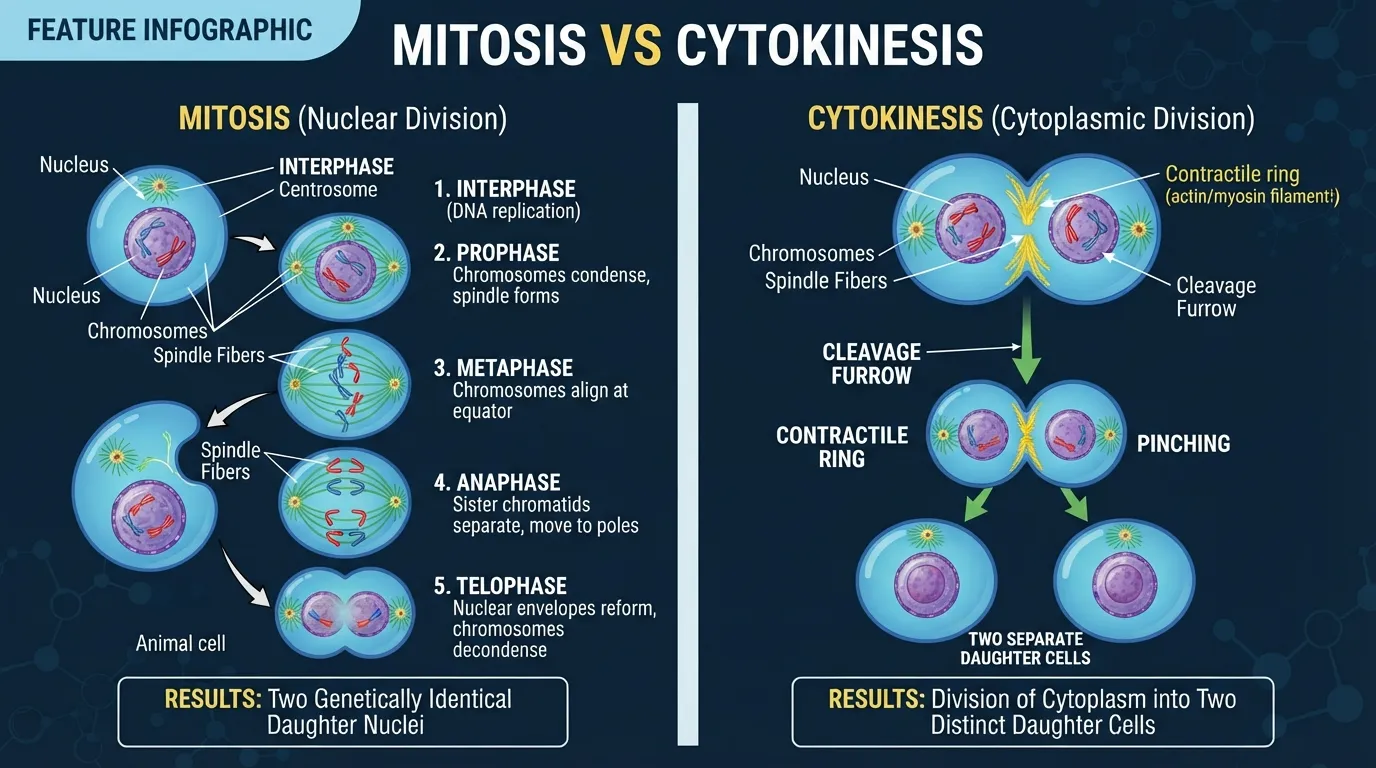
A biology teacher holds up two pictures in class. One shows a cell’s insides pulling apart into two sets. The other shows the whole cell splitting into two cells. A student raises her hand. She asks, “Aren’t these the same thing?” The teacher smiles. This mix-up happens every year. The truth is, these pictures show two steps in one big process. Mitosis is when a cell’s core parts split and copy. Cytokinesis is when the whole cell splits into two full cells. Knowing the difference between mitosis and cytokinesis helps students pass tests. It also helps future doctors understand how our bodies grow and heal. This guide breaks down the difference between mitosis and cytokinesis in clear, simple steps.
Key Difference Between the Both
In short: mitosis is the step where a cell’s nucleus splits. It copies and splits the genetic material inside. Cytokinesis is the next step. It splits the whole cell into two separate cells.
Why Is Their Difference Necessary to Know for Learners and Experts?
For biology students, this is one of the first big ideas about how life grows and heals. Mixing up the two steps leads to wrong test answers. It also leads to a weak grasp of how cells work. For doctors and scientists, this gap matters even more. Cancer often starts when cell division goes wrong. Knowing which step failed — mitosis or cytokinesis — can guide real treatment research. For all of us, this basic cell knowledge helps medicine, farming, and our grasp of how a simple cut heals.
Pronunciation
- Mitosis
- US: /maɪˈtoʊ.sɪs/ (my-TOH-sis)
- UK: /maɪˈtəʊ.sɪs/ (my-TOH-sis)
- Cytokinesis
- US: /ˌsaɪ.toʊ.kɪˈniː.sɪs/ (sy-toh-kih-NEE-sis)
- UK: /ˌsaɪ.təʊ.kɪˈniː.sɪs/ (sy-toh-kih-NEE-sis)
Difference Between the Keywords
1. Definition Mitosis is the step where a cell’s nucleus splits into two sets. Cytokinesis is the step where the whole cell splits into two cells. Example 1: During mitosis, a skin cell’s DNA splits into two matching copies. Example 2: During cytokinesis, that same skin cell splits into two full cells.
2. Order of Events Mitosis happens first. Cytokinesis happens right after. It often starts before mitosis fully ends. Example 1: A cell finishes splitting its nucleus during mitosis. Example 2: Right after, the cell wall pinches in during cytokinesis. This makes two cells.
3. What Splits Mitosis splits the nucleus and its genetic material. Cytokinesis splits the rest of the cell and the whole cell body. Example 1: Mitosis moves chromosomes to opposite ends of the cell. Example 2: Cytokinesis splits the outer cell part. This forms two full cells.
4. Number of Steps Mitosis has four main stages. They are prophase, metaphase, anaphase, and telophase. Cytokinesis is one single step. It overlaps with the last stage of mitosis. Example 1: A textbook lists four clear stages under mitosis. Example 2: That same book lists cytokinesis as one final step, right after those four stages.
5. Result Mitosis ends with two nuclei. Each one has a full, matching set of chromosomes. Cytokinesis ends with two full, separate cells. Each one has its own nucleus. Example 1: After mitosis, one cell holds two nuclei inside it for a short time. Example 2: After cytokinesis, those two nuclei end up in two separate, full cells.
6. Cell Type Differences Mitosis works the same basic way in most animal and plant cells. Cytokinesis looks different in each type. Animal cells pinch inward. Plant cells build a new wall down the middle. Example 1: An animal cell’s outer wall pinches inward, like a drawstring bag, during cytokinesis. Example 2: A plant cell builds a “cell plate” down the middle during cytokinesis, since it has a hard wall.
7. Errors and Effects Errors in mitosis can lead to cells with the wrong number of chromosomes. Errors in cytokinesis can leave one large cell with two nuclei, instead of two normal cells. Example 1: A mitosis error can cause a cell to end up with an extra chromosome. Example 2: A cytokinesis error can leave a cell that failed to fully split. It holds double the normal DNA.
8. Timing Within the Cell Cycle Mitosis has its own name in the cell cycle. It is called the M phase. Cytokinesis is often grouped as the final part of that same M phase. Example 1: A cell cycle chart labels mitosis as its own phase. Example 2: That same chart may show cytokinesis as a small piece at the end of mitosis.
9. Visibility Under a Microscope Mitosis is easy to spot under a microscope. You watch chromosomes move and line up. Cytokinesis is easy to spot too. You watch the cell’s outer shape pinch or split in two. Example 1: A student sees chromosomes line up in the middle during mitosis. Example 2: That same student then sees the cell’s edge pinch apart during cytokinesis.
10. Role in the Body Mitosis makes sure genetic material is copied right before a cell splits. Cytokinesis makes sure that copied material gets split fair into two working cells. Example 1: Mitosis helps a cut heal by copying skin cell DNA the right way. Example 2: Cytokinesis then makes sure that healing cut gets two full new skin cells, not one messy blob.
Nature and Behaviour
Mitosis works like a careful copy machine. It works quietly inside the cell. It sorts and splits genetic material with great care, so each new set matches the first one.
Cytokinesis works like the final cut of a pair of scissors. Once the copying is done, it steps in. It cuts the cell in two, giving each new half its own space and its own parts.
Why Are People Confused About Their Use?
Many students mix up mitosis and cytokinesis. They happen so close together in time, and they often overlap near the end. Textbooks group them under one big heading, “cell division.” They don’t always make clear that these are two separate steps. Since both end with a cell becoming two, it’s easy to think of them as one event. But mitosis handles the genetic material, and cytokinesis handles the split of the whole cell.
Comparison Table
| Aspect | Mitosis | Cytokinesis |
| What Splits | Nucleus and genetic material | Whole cell body |
| Order | Happens first | Happens right after |
| Stages | Four main stages | One main step |
| Result | Two matching nuclei | Two full, separate cells |
| Cell Type Difference | Mostly the same in all cells | Differs in animal vs plant cells |
| Similarity | Part of cell division | Part of cell division |
| Similarity | Needed for growth and healing | Needed for growth and healing |
| Similarity | Can go wrong and cause health issues | Can go wrong and cause health issues |
Which Is Better in What Situation?
Neither step is “better.” A cell needs both to fully and correctly divide. Mitosis matters most when we study how genetic material is copied and sorted. This is key in cancer research, where scientists study how bad mitosis can lead to disease. Cytokinesis matters most when we study how a cell splits into two working parts. This is key in tissue growth, wound healing, and some birth defects tied to failed cell splitting. In truth, both steps must work together, in the right order, for healthy growth to happen.
Metaphors and Similes Using the Keywords
- “The team split its work like mitosis, copying every task before dividing the load.”
- “Their group broke apart like cytokinesis, clean and final, into two new teams.”
- “Ideas grew in the room like cells in mitosis, each one a matching copy.”
Connotative Meaning
Mitosis carries a neutral, scientific tone. It’s rarely used outside biology class. In metaphors, it can suggest careful copying or growth.
Cytokinesis also carries a neutral, technical tone. It’s used mostly in science writing. In metaphor, it can suggest a clean, final split.
Idioms and Proverbs
There are no old, common idioms or proverbs built around “mitosis” or “cytokinesis.” Both are modern science terms tied to biology class and lab work, not everyday folk speech.
Works in Literature
- The Immortal Life of Henrietta Lacks — non-fiction that touches on cell division and cell research (non-fiction, Rebecca Skloot, 2010)
- Micrographia — an early science book that helped shape the study of cells, though it came before terms like mitosis (non-fiction, Robert Hooke, 1665)
Movies Made on the Keywords
There are no major films built entirely around “mitosis” or “cytokinesis” by name. But many science shows and school films use animation to show these two cell steps as part of wider biology topics.
Frequently Asked Questions
1. Does cytokinesis happen without mitosis? Normally, no. Cytokinesis follows mitosis, since the cell must first sort its genetic material before it can safely split.
2. Can mitosis happen without cytokinesis? In rare cases, yes. This can cause problems, like a cell ending up with two nuclei instead of splitting into two full cells.
3. Which one takes longer, mitosis or cytokinesis? Mitosis, with its four stages, usually takes longer than cytokinesis. Cytokinesis is a quicker, more direct final step.
4. Do plant and animal cells go through both steps the same way? Mitosis looks fairly similar in both. Cytokinesis is not the same. Animal cells pinch inward, while plant cells build a new wall between the two halves.
5. Why do scientists study these two steps on their own? Studying them apart helps scientists find exactly where a problem starts — in copying genetic material, or in the final split of the cell.
How Both Are Useful for Surroundings
Mitosis and cytokinesis power growth, healing, and life itself. This runs from a child growing taller to a cut on your skin closing up in a few days. These steps also support big fields like cancer research, since many cancers start when cell division goes wrong at one of these stages. In farming, understanding cytokinesis in plant cells helps grow and repair crops, which supports food for whole communities.
Final Words
Mitosis stands as the careful, exact way a cell copies and sorts its genetic material. Cytokinesis stands as the final, physical step that turns one cell into two working cells. Neither one replaces the other. Healthy growth needs both, in the right order, every time.
Conclusion
The difference between mitosis and cytokinesis comes down to what each step splits. Mitosis divides the nucleus and its genetic material. Cytokinesis divides the whole cell body into two separate cells. Both are part of the same big process of cell division, and both must work right for healthy growth and healing. Knowing the difference between mitosis and cytokinesis helps students grasp biology more clearly. It also helps future scientists and doctors understand how the body grows, heals, and sometimes goes wrong.

I’m Zahid Abbas, an educator, researcher, and digital publishing strategist with a passion for linguistics, grammar, and clear communication. As a content creator and SEO specialist, I craft research-driven, reader-focused content that empowers learners and makes knowledge accessible worldwide.










