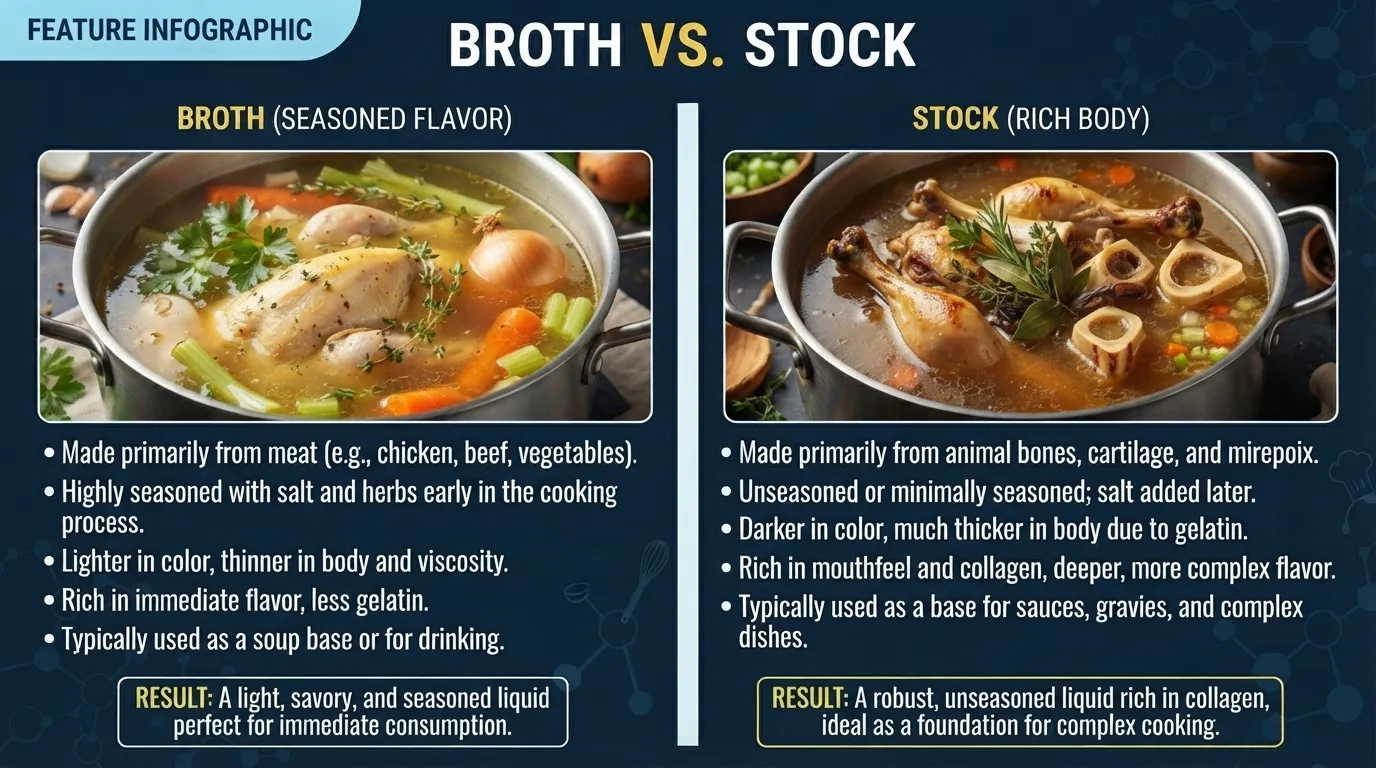
A new cook once stood in his kitchen, staring at two recipes side by side. One recipe called for “chicken broth,” and the other called for “chicken stock.” He asked his mom on the phone, “Aren’t these just the same thing?” She laughed and told him they were close, but not quite the same. This mix-up happens to home cooks all the time. Broth and stock both start as a pot of simmered liquid, but the difference between a broth and a stock shapes how a dish turns out in the end. Knowing broth vs stock helps a cook pick the right base, so every soup, sauce, or stew tastes just right.
Key Difference Between a Broth and a Stock
The main difference between a broth and a stock comes down to what goes into the pot. Broth is made mostly from meat, and sometimes veggies, simmered in water for a shorter time. Stock is made mostly from bones, simmered for a much longer time, which pulls out a rich, thick body from the bones. Broth tends to taste light and savory. Stock tends to taste deep and full, almost like a base you build other flavors on top of.
Why This Difference Matters
Knowing broth vs stock matters for home cooks, chefs, and food lovers alike. If a recipe calls for stock, but a cook uses broth instead, a soup or sauce may turn out too thin or too salty. For chefs and food writers, using the right word helps set clear steps in a recipe, so a dish comes out the same way each time. For daily life, this small bit of kitchen knowledge helps home cooks save money, avoid waste, and cook meals that taste rich and full, just as planned.
Pronunciation
| Word | US | UK |
| Broth | “brawth” | “broth” (short “o,” like in “hot”) |
| Stock | “stahk” | “stok” |
Difference Between a Broth and a Stock
- Main Ingredient Broth is made mostly from meat, often with some bone still on it. Stock is made mostly from bones alone, often with little to no meat. Example 1: A chicken broth may use a whole cut of chicken meat and bone. Example 2: A chicken stock may use just the leftover bones from a roasted bird.
- Cook Time Broth cooks for a shorter time, often under two hours. Stock cooks for a much longer time, often four hours or more. Example 1: A quick veggie broth may be ready in about 45 minutes. Example 2: A rich beef stock may need to simmer for six hours or more.
- Texture Broth tends to stay thin and light. Stock tends to turn thick and rich, almost like jelly when it cools. Example 1: A clear chicken broth pours out thin, like tea. Example 2: A cold beef stock can turn into a wobbly, jelly-like block in the fridge.
- Flavor Broth tastes light, savory, and often gets salt added while it cooks. Stock tastes deep and full, but stays mostly plain, with salt added later in a recipe. Example 1: A bowl of chicken broth can be enjoyed on its own, lightly salted. Example 2: Plain beef stock rarely gets sipped alone, since it’s meant as a base for other dishes.
- Use in Cooking Broth often gets used on its own, as a light soup or drink. Stock often gets used as a base, mixed into sauces, gravies, and other dishes. Example 1: A sick child may sip warm chicken broth to feel better. Example 2: A chef may pour beef stock into a rich gravy to add deep flavor.
- Bone Content Broth uses little to no bone, or bone with lots of meat still on it. Stock leans heavily on bone, often roasted first for extra flavor. Example 1: A veggie broth may skip bones and meat completely. Example 2: A stock may use roasted beef bones to build a deep, dark flavor.
- Nutrient Content Broth holds nutrients mostly from meat and light simmering. Stock holds more nutrients pulled from bones, like collagen, due to the long cook time. Example 1: A broth may offer light protein from simmered meat. Example 2: A long-cooked stock may offer more collagen, which can support joints and skin.
- Common Use in Recipes Broth often stands alone as a simple soup base or light drink. Stock often plays a background role, boosting other dishes with rich flavor. Example 1: A recipe may call for “chicken broth” as the main liquid in a soup. Example 2: A recipe may call for “beef stock” as a small but key part of a stew’s flavor.
- Clarity Broth often looks a bit cloudy, since it simmers for a shorter time with meat still in it. Stock often looks clear, since it’s strained well after a long simmer. Example 1: A quick veggie broth may look a bit hazy in the pot. Example 2: A well-made stock often looks clear and golden after straining.
- Store-Bought Labels Store shelves often list “broth” for light, ready-to-drink soups. Store shelves often list “stock” for richer bases meant to cook into other dishes. Example 1: A can of “chicken broth” may be sipped straight from a mug. Example 2: A carton of “beef stock” is often stirred into a pot of rice or gravy.
How They Act
Broth: Broth acts light and simple, standing on its own as a warm, tasty drink or a base for a quick, easy soup. It doesn’t ask for much time in the kitchen.
Stock: Stock acts as a quiet, patient helper in the background. It takes hours to build, but it lends deep, rich flavor to sauces, gravies, and soups that need more body.
Why People Mix Them Up
People mix up broth and stock because both start the same way: a pot of water, simmered with meat, bones, or veggies. Store labels don’t always help either, since some brands use the words loosely or even swap them by mistake. Since both liquids end up looking similar in a pot, and both get used in soups, the line between them can feel blurry to a home cook.
Comparison Table
| Feature | Broth | Stock |
| Main base | Meat | Bones |
| Cook time | Shorter (30 min–2 hrs) | Longer (4+ hrs) |
| Texture | Thin | Thick, jelly-like when cold |
| Flavor | Light, savory | Deep, rich, plain |
| Salt | Often added while cooking | Often added later |
| Common use | Standalone soup or drink | Base for sauces, gravies |
| Nutrients | Light protein | More collagen |
| Clarity | Slightly cloudy | Often clear |
| Bone use | Little to none | Heavy |
| Store label | Ready to drink | Cooking base |
Which Fits Which Case?
When broth fits: If you want a light, tasty drink, or a quick base for a simple soup, broth is the right pick. It works well when you’re short on time, feeling under the weather, or just want a warm, comforting sip.
When stock fits: If you’re building a rich sauce, gravy, or stew, stock is the stronger choice. Its deep, full body adds real strength to a dish, especially when a recipe needs more than just a light, watery base.
Metaphors and Similes
- “Their friendship ran deep, like a slow-simmered stock” — means it grew strong and rich over time.
- “Her comfort was as simple and warm as a bowl of broth” — means it felt light, easy, and soothing.
- “The city’s culture is a rich stock, built from many old traditions” — means it holds deep, layered roots.
- These food terms fit naturally into daily metaphors, since warmth and depth are easy ideas to picture.
Connotative Meanings
Broth:
- Positive: “This broth is just what I needed” — means it feels warm and soothing.
- Neutral: “The recipe calls for two cups of broth” — just states a fact.
- Broth rarely carries a negative tone, since it’s tied to comfort and simple care.
Stock:
- Positive: “This stock gives the soup so much depth” — means it adds real value and richness.
- Neutral: “I keep stock in the freezer for later use” — just states a fact.
- Negative (rare): “The stock tastes too plain on its own” — reflects its role as a base, not a finished dish.
Idioms and Proverbs
“Stock” shows up in a few well-known sayings, while “broth” connects to one famous old proverb:
- “Too many cooks spoil the broth” — “The project failed since everyone gave orders; too many cooks spoil the broth.”
- “Take stock of something” — “Before the big move, they took stock of all their old belongings.”
- “In stock” — “The store still has that item in stock,” meaning it’s still available.
Books and Movies
Broth and stock are kitchen terms, so they rarely stand as a main theme in books or films, though food-based works often touch on them:
- The Soul of a Chef — nonfiction book, Michael Ruhlman, 2000 (touches on classic cooking base skills, including stock-making)
- Kitchen Confidential — memoir, Anthony Bourdain, 2000 (touches on real kitchen life, including basics like stock and broth)
No major films are built directly around broth or stock as a main topic, since these are cooking basics, not common story themes. Food-based films, like Chef (2014, USA), touch on cooking skill and passion in a wider way.
Five Common Questions
1. Can I use broth instead of stock in a recipe? Yes, in most cases, though the dish may turn out lighter and less rich than if made with stock.
2. Why does stock turn into jelly when it’s cold? This happens because of collagen pulled from the bones during a long simmer, which thickens as it cools.
3. Is bone broth the same as stock? Bone broth sits close to stock, since both use bones and simmer a long time, though bone broth often simmers even longer for added nutrients.
4. Can I freeze broth or stock? Yes, both freeze well and can be kept for months, making them easy to prepare ahead of time.
5. Which one is healthier, broth or stock? Both offer health value, but stock often holds more collagen and minerals, due to its longer cook time with bones.
How Both Are Useful
Broth and stock both help cooks build tasty, healthy meals with less waste. Broth offers a light, simple way to enjoy a warm drink or quick soup. Stock offers a rich base that boosts the flavor of sauces, stews, and gravies. Together, they help home cooks turn simple, leftover bones and scraps into deep, satisfying meals, which supports both good taste and a low-waste kitchen.
Final Words
Broth stands for light comfort, ready in less time and easy to enjoy on its own. Stock stands for patient depth, built slowly to support richer dishes. Both liquids serve the kitchen in their own way, and knowing their real difference can help any cook build better, tastier meals.
Conclusion
Difference between a broth and a stock comes down to base ingredients, cook time, and texture. Broth is light, quick, and often enjoyed on its own. Stock is rich, slow-cooked, and built to boost other dishes with deep flavor. Knowing broth vs stock helps home cooks pick the right base for the right dish, avoiding thin sauces or overly heavy soups. Whether you’re cooking a quick meal, building a rich stew, or just curious about kitchen terms, understanding broth and stock gives you a clearer, tastier grip on what goes into your favorite dishes.

I’m Zahid Abbas, an educator, researcher, and digital publishing strategist with a passion for linguistics, grammar, and clear communication. As a content creator and SEO specialist, I craft research-driven, reader-focused content that empowers learners and makes knowledge accessible worldwide.










