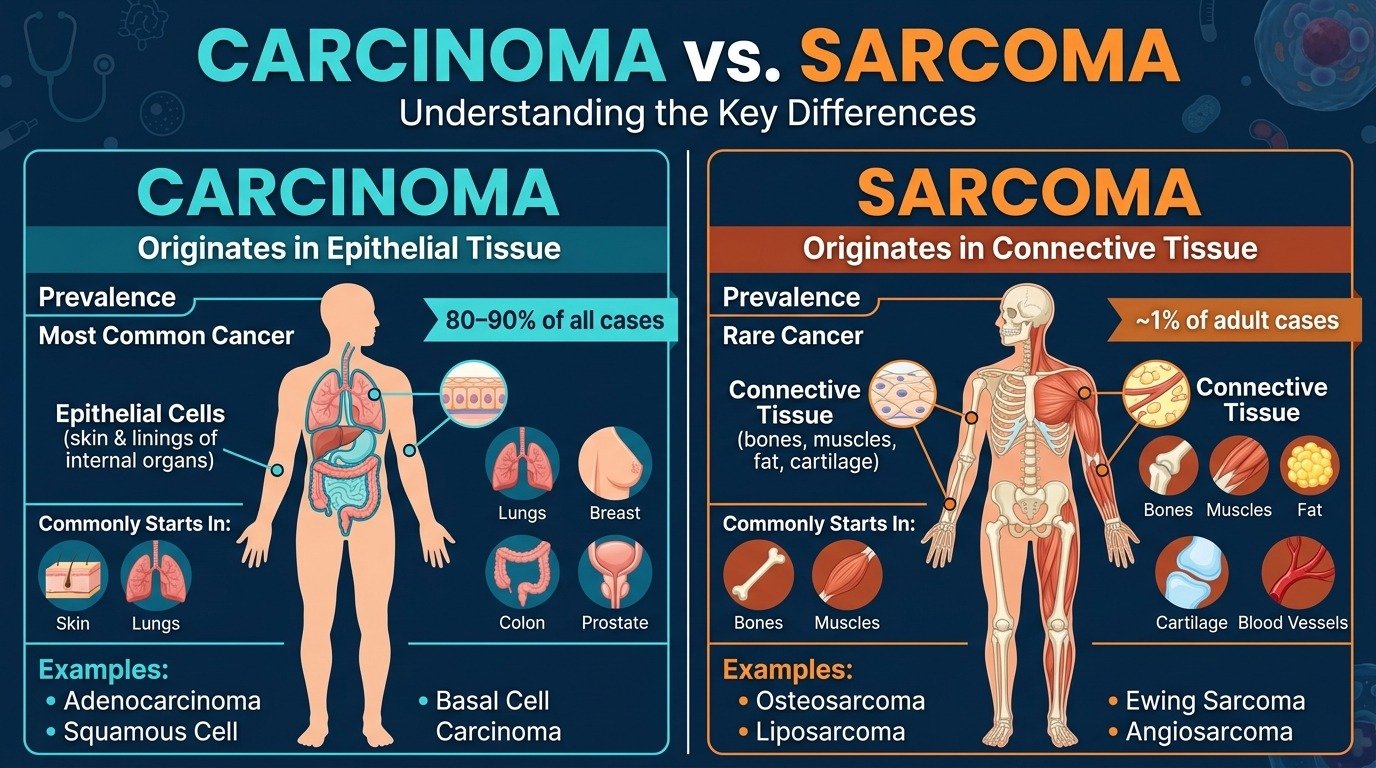
Imagine a doctor telling two patients that they have cancer. One patient has a tumor that started in the bone, while the other has a tumor that started in the lung. Both conditions are cancer, but they are not the same. Sarcoma is a cancer that begins in connective or supportive tissues, such as bone, muscle, fat, cartilage, or blood vessels. Carcinoma begins in epithelial cells. These cells cover the skin and line many organs.
This simple difference helps explain the difference between sarcoma and carcinoma. Learning the difference between sarcoma and carcinoma is important because the two cancers can behave and respond to treatment differently. Understanding the difference between sarcoma and carcinoma also helps learners, patients, families, and health workers understand cancer better.
Key Difference Between the Both
The main difference is where the cancer starts. Sarcoma starts in connective or supportive tissues. Carcinoma starts in epithelial cells that cover or line body surfaces and organs.
Why Is Their Difference Necessary to Know for Learners and Experts?
Knowing the difference helps people understand cancer reports and medical discussions. For students, it builds basic medical knowledge. For health professionals, the distinction helps with diagnosis, treatment planning, and research. For society, better knowledge can reduce fear and confusion about cancer.
Pronunciation of Both
- Sarcoma: US: sar-KOH-muh | UK: sar-KOH-muh
- Carcinoma: US: kar-suh-NOH-muh | UK: kar-sih-NOH-muh
Now that the basic meaning is clear, let us look at ten simple differences between sarcoma and carcinoma.
Difference Between the Keywords
1. Place Where the Cancer Starts
Sarcoma:
Sarcoma starts in connective or supportive tissues. These include bone, muscle, fat, cartilage, and blood vessels.
Examples:
- Osteosarcoma begins in bone.
- Liposarcoma begins in fat tissue.
Carcinoma:
Carcinoma starts in epithelial cells. These cells cover the outside of the body and line many organs.
Examples:
- Lung carcinoma can begin in cells lining the lung.
- Skin carcinoma can begin in skin cells.
2. Main Types of Tissue Involved
Sarcoma:
Sarcomas mainly affect tissues that support, connect, or move the body.
Examples:
- A sarcoma may develop in muscle tissue.
- A sarcoma may develop in cartilage.
Carcinoma:
Carcinomas mainly affect epithelial tissue.
Examples:
- A carcinoma may develop in breast tissue.
- A carcinoma may develop in the lining of the stomach.
3. Common Forms
Sarcoma:
Sarcoma has two broad groups: bone sarcomas and soft-tissue sarcomas.
Examples:
- Osteosarcoma is a type of bone sarcoma.
- Leiomyosarcoma is a type of soft-tissue sarcoma.
Carcinoma:
Carcinoma has several major forms based on the type of epithelial cell involved.
Examples:
- Adenocarcinoma develops from gland-forming epithelial cells.
- Squamous cell carcinoma develops from squamous cells.
4. Common Body Locations
Sarcoma:
Sarcomas can occur in many parts of the body. They may develop in an arm, leg, abdomen, chest, or bone.
Examples:
- A sarcoma may form in the thigh.
- A sarcoma may form in a bone near the knee.
Carcinoma:
Carcinomas can also occur in many organs.
Examples:
- Carcinoma can occur in the lung.
- Carcinoma can occur in the colon.
5. How They Are Classified
Sarcoma:
Doctors often classify sarcoma by the tissue where it started.
Examples:
- A tumor starting in bone may be classified as osteosarcoma.
- A tumor starting in fat may be classified as liposarcoma.
Carcinoma:
Carcinoma is often classified by the type of epithelial cell and the organ involved.
Examples:
- A tumor from gland-forming cells may be called adenocarcinoma.
- A tumor from squamous cells may be called squamous cell carcinoma.
6. How They May Spread
Sarcoma:
Sarcoma can spread to other parts of the body. The pattern depends on the specific sarcoma.
Examples:
- Some sarcomas can spread to the lungs.
- Some sarcomas can spread to other bones.
Carcinoma:
Carcinoma can also spread to other organs through the blood or lymphatic system.
Examples:
- Some lung carcinomas can spread to the brain.
- Some breast carcinomas can spread to the bones.
7. How Common They Are
Sarcoma:
Sarcomas are relatively uncommon cancers compared with carcinomas.
Examples:
- Bone sarcomas are uncommon compared with many common cancers.
- Soft-tissue sarcomas are also relatively rare.
Carcinoma:
Carcinomas are very common because many cancers that affect major organs and body surfaces are carcinomas.
Examples:
- Many breast cancers are carcinomas.
- Many lung cancers are carcinomas.
8. Typical Signs and Symptoms
Sarcoma:
Symptoms depend on where the sarcoma develops.
Examples:
- A soft-tissue sarcoma may cause a growing lump.
- A bone sarcoma may cause bone pain or swelling.
Carcinoma:
Symptoms also depend on the organ involved.
Examples:
- Lung carcinoma may cause a persistent cough or breathing problems.
- Colon carcinoma may cause changes in bowel habits or blood in the stool.
Important: These symptoms can have many causes. Having one of them does not mean a person has cancer.
9. Treatment
Sarcoma:
Treatment depends on the type, location, stage, and other features of the cancer. Surgery, radiation, chemotherapy, targeted therapy, or other treatments may be used.
Examples:
- Surgery may be used to remove a localized sarcoma.
- Chemotherapy may be used for some types of sarcoma.
Carcinoma:
Treatment also depends on the cancer’s type and stage.
Examples:
- Surgery may remove an early carcinoma.
- Some carcinomas may be treated with targeted or immune-based therapies.
10. Prognosis
Sarcoma:
The outlook depends on factors such as the sarcoma type, size, location, grade, stage, and response to treatment.
Examples:
- A small sarcoma found early may have a better outlook than an advanced one.
- A sarcoma that has spread may require more complex treatment.
Carcinoma:
The outlook also varies widely.
Examples:
- An early carcinoma may be highly treatable.
- An advanced carcinoma may require several types of treatment.
Remember: No single rule can predict the outcome for every patient. Doctors use detailed medical information to estimate prognosis.
Nature and Behaviour of Sarcoma
Sarcoma is a broad group of cancers. It can develop in bone or soft tissues. Some sarcomas grow slowly, while others can grow quickly. Their behavior depends on the exact type and grade.
A sarcoma may first appear as a lump, swelling, or pain. However, symptoms vary by location. Some sarcomas are deep inside the body and may not cause clear symptoms at first.
Nature and Behaviour of Carcinoma
Carcinoma is also a broad group of cancers. It starts in epithelial cells. These cells are found on the skin and in the lining of many organs.
Different carcinomas behave differently. Some grow slowly. Others can grow quickly and spread to other parts of the body. Their behavior depends on the type, stage, grade, and other biological features.
also read more about https://comparificationn.com/difference-between-revenue-and-sales-2/
Why Are People Confused About Their Use?
People often confuse sarcoma and carcinoma because both are types of cancer. Both can form tumors. Both can spread to other parts of the body. Both can require surgery, chemotherapy, radiation, or other treatments.
The word sarcoma tells us about the type of tissue where the cancer began. The word carcinoma tells us that the cancer began in epithelial cells.
Another reason for confusion is that both names can have many subtypes. For example, osteosarcoma and adenocarcinoma sound similar because both end in “-sarcoma” or “-carcinoma,” but they describe different groups of cancer.
Sarcoma vs. Carcinoma: Difference and Similarity
| Feature | Sarcoma | Carcinoma |
| Basic meaning | Cancer of connective or supportive tissue | Cancer of epithelial cells |
| Main tissue | Bone and soft tissue | Skin and organ lining |
| Common examples | Osteosarcoma, liposarcoma | Adenocarcinoma, squamous cell carcinoma |
| Can spread? | Yes | Yes |
| Can form tumors? | Yes | Yes |
| Treatment | Depends on type and stage | Depends on type and stage |
| Surgery may be used | Yes | Yes |
| Chemotherapy may be used | Sometimes | Sometimes |
| Radiation may be used | Sometimes | Sometimes |
| Are they cancer? | Yes | Yes |
| Are they the same? | No | No |
Which Is Better in What Situation?
When Is Sarcoma the Relevant Term?
Sarcoma is the relevant term when a cancer begins in connective or supportive tissues such as bone, muscle, fat, cartilage, or blood vessels. It is useful when doctors need to identify the exact cancer type and tissue of origin. For example, a cancer that begins in bone may be classified as a bone sarcoma. A cancer that begins in fat tissue may be a liposarcoma. The term helps doctors select the right tests and treatment plan. However, sarcoma is not “better” than carcinoma. They are different cancer groups, and each needs care based on its own features.
When Is Carcinoma the Relevant Term?
Carcinoma is the relevant term when cancer begins in epithelial cells. These cells cover the skin and line many organs. For example, many breast, lung, colon, prostate, and skin cancers are carcinomas. The term helps doctors describe the cancer accurately. Different carcinomas can behave in very different ways, so the exact type and stage matter greatly. Carcinoma is not better or worse than sarcoma. The correct term simply depends on where the cancer started and what kind of cells became cancerous.
How Are the Keywords Used in Metaphors and Similes?
Medical words such as sarcoma and carcinoma are normally used in their literal medical sense. They are not common metaphorical words in everyday English.
Sarcoma
Metaphor:
- “The sarcoma was an unwanted storm in the patient’s life.”
Simile:
- “The sudden diagnosis felt like a heavy cloud over the family.”
These examples use the idea of illness as a difficult experience. They do not change the medical meaning of sarcoma.
Carcinoma
Metaphor:
- “The carcinoma became a hidden enemy inside the body.”
Simile:
- “The cancer journey felt like a long climb up a steep hill.”
Again, these are figurative descriptions of the experience, not medical definitions.
Connotative Meaning of Sarcoma and Carcinoma
Sarcoma
- Positive: Neutral by itself. The word is a medical diagnosis, not a positive idea.
- Negative: It can carry fear because it refers to cancer.
- Neutral: In medical writing, it is mainly a precise clinical term.
Example:
“The biopsy confirmed a type of sarcoma.”
Carcinoma
- Positive: Neutral as a word; it does not describe something positive.
- Negative: It can create fear because it refers to cancer.
- Neutral: Doctors use it as a medical term to identify a type of cancer.
Example:
“The report identified an early-stage carcinoma.”
Idioms and Proverbs Related to the Words
There are no common traditional English idioms or proverbs that directly use the words sarcoma or carcinoma. These are medical terms.
However, some common expressions are often used when talking about serious illness.
“Fight a battle”
Example:
“She is fighting a difficult battle against cancer.”
“A long road”
Example:
“Treatment can be a long road, but patients may have strong support from family and doctors.”
These expressions are figurative. They do not describe the medical behavior of sarcoma or carcinoma.
Works in Literature Related to the Keywords
The exact words sarcoma and carcinoma are medical terms, so they are not common themes in classic literature. However, several important works explore cancer, illness, and the experience of patients.
- The Death of Ivan Ilyich — Novella, Leo Tolstoy, 1886. It explores illness, pain, fear, and death.
- The Fault in Our Stars — Young adult novel, John Green, 2012. It focuses on young people living with cancer.
- The Cancer Journals — Memoir, Audre Lorde, 1980. It discusses the author’s experience with breast cancer.
- Love Story — Romance novel, Erich Segal, 1970. Its story includes serious illness and loss.
These works relate to cancer or illness, rather than being books specifically about sarcoma and carcinoma.
Movies Related to the Keywords
There are few major films specifically about sarcoma or carcinoma as medical terms. However, several films explore cancer and the lives of people facing serious illness.
- The Fault in Our Stars — 2014, United States. A romantic drama involving two young people living with cancer.
- 50/50 — 2011, United States. A comedy-drama about a young man dealing with cancer.
- Love Story — 1970, United States. A romantic drama involving serious illness.
- Wit — 2001, United States. A drama about a professor receiving treatment for advanced cancer.
- Terms of Endearment — 1983, United States. A drama that includes a major cancer storyline.
Frequently Asked Questions
1. What is the main difference between sarcoma and carcinoma?
Sarcoma starts in connective or supportive tissues, such as bone and soft tissue. Carcinoma starts in epithelial cells that cover the body or line organs.
2. Is sarcoma more serious than carcinoma?
Not always. Both can be serious. The outlook depends on the exact cancer type, stage, grade, location, and response to treatment.
3. Is sarcoma a type of cancer?
Yes. Sarcoma is a group of cancers that begin in connective or supportive tissues.
4. Is carcinoma a type of cancer?
Yes. Carcinoma is a group of cancers that begin in epithelial cells.
5. Can both sarcoma and carcinoma spread?
Yes. Both can spread to other parts of the body. The way they spread depends on the specific cancer.
How Are Both Useful for Their Surroundings?
Sarcoma and carcinoma are not “useful” to the body or environment. They are diseases that can harm the body. However, studying them has important benefits for society.
Research on sarcoma can help scientists understand rare cancers and develop better tests and treatments. Research on carcinoma has helped improve screening, diagnosis, surgery, medicines, and cancer prevention.
Learning about both also helps people understand warning signs and the importance of medical care. It can support better health education and reduce confusion about cancer.
Final Words for Both
Sarcoma and carcinoma are both types of cancer, but they begin in different tissues.
Sarcoma mainly begins in connective or supportive tissues, including bone, muscle, fat, and cartilage.
Carcinoma begins in epithelial cells, which cover the body and line many organs.
Neither is “better” or “worse” simply because of its name. Every cancer is different. Doctors look at the exact type, stage, grade, location, and other features before deciding on treatment.
Understanding this difference makes medical language easier to understand and helps people communicate more clearly about cancer.
Conclusion
The difference between sarcomhttps://www.cancercenter.com/community/blog/2023/08/carcinoma-vs-sarcomaa and carcinoma mainly comes down to where the cancer begins. Sarcoma starts in connective or supportive tissues, while carcinoma starts in epithelial cells. Both are broad groups with many different subtypes. They can occur in different parts of the body, grow at different speeds, and require different treatment plans.
Knowing the difference between sarcoma and carcinoma is useful for students, health workers, patients, and families. It can make medical information easier to understand. Still, a cancer diagnosis cannot be judged by its name alone. The exact type, stage, grade, and other medical details are important. When people understand these basic terms, they can have clearer and more informed conversations with healthcare professionals.

I’m Zahid Abbas, an educator, researcher, and digital publishing strategist with a passion for linguistics, grammar, and clear communication. As a content creator and SEO specialist, I craft research-driven, reader-focused content that empowers learners and makes knowledge accessible worldwide.










