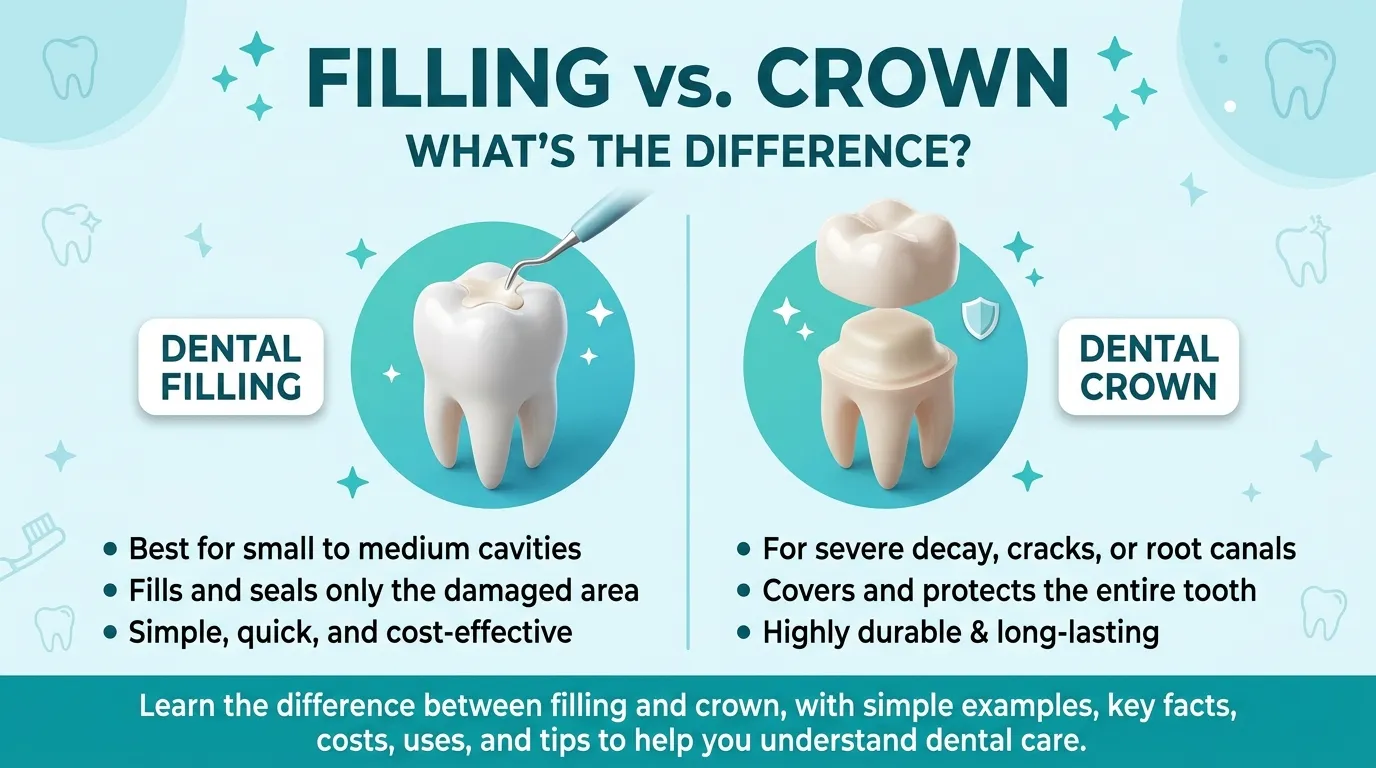
Tom has a toothache. His dentist finds a small hole in his tooth. The dentist cleans the hole and fills it with a special material. This is called a filling. Now, think of Lisa. Her tooth is badly damaged, and a simple filling may not be enough. Her dentist places a cap over the tooth to protect it. This is called a crown.
The difference between filling and crown is mainly about how much of the tooth needs care. A filling repairs a small or medium hole in a tooth. A crown covers and protects a teeth that is weak or badly damaged. Both treatments help people keep their natural teeth. Knowing the difference between filling and crown can help you understand your dentist’s advice and make better choices for your oral health.
Key Difference Between the Two
A filling repairs a damaged part of a tooth. It fills the space left by decay or a small break.
A crown covers most or all of the visible part of a tooth. It helps protect a weak, cracked, or badly damaged tooth.
In simple words, a filling fixes a part of the tooth, while a crown covers the tooth.
Why Is Their Difference Important for Learners, Experts, and Society?
Knowing the difference between a filling and a crown helps people understand dental care. It can help patients ask clear questions and understand why a dentist suggests one treatment over the other.
Dental workers also need this knowledge to explain care in simple words. Teachers and health writers can use it to share correct facts about teeth.
This knowledge matters to society because healthy teeth help people eat, speak, and smile with ease. Early care may also stop a small problem from becoming worse. Still, only a dentist can check a tooth and choose the right treatment.
Pronunciation of Filling and Crown
| Word | US pronunciation | UK pronunciation |
| Filling | /ˈfɪl.ɪŋ/ | /ˈfɪl.ɪŋ/ |
| Crown | /kraʊn/ | /kraʊn/ |
Difference Between Filling and Crown
1. Main Purpose
Filling
A filling repairs a hole or a small damaged part of a tooth. It helps stop decay from getting worse.
Examples:
- Mia gets a filling to repair a small hole in her back tooth.
- Ben needs a filling after his dentist removes tooth decay.
Crown
A crown covers and protects a tooth that needs more support.
Examples:
- Jack gets a crown to protect a weak tooth.
- Sara gets a crown after a large part of her tooth breaks.
2. How Much of the Tooth It Covers
Filling
A filling repairs only the part of the tooth that has been damaged.
Examples:
- A small filling repairs a hole in one side of a tooth.
- A dentist uses a filling to fix a small chip in a tooth when suitable.
Crown
A crown covers most or all of the visible part of a tooth.
Examples:
- A crown covers a tooth that has lost a lot of its hard outer part.
- A crown protects a tooth after root canal treatment when a dentist finds it is needed.
3. Level of Tooth Damage
Filling
A filling is often used when the damage is small or medium in size and enough healthy tooth remains.
Examples:
- A small area of decay is treated with a filling.
- A tooth with a small hole may need only a filling.
Crown
A crown may be used when a tooth is badly damaged or weak.
Examples:
- A tooth with a large break may need a crown.
- A weak tooth with a large old filling may need a crown for support.
4. Materials Used
Filling
Fillings can be made from different materials. Common choices include tooth-coloured composite resin, glass ionomer, and dental amalgam.
Examples:
- A dentist uses composite resin to fill a front tooth.
- A dentist may use glass ionomer for some fillings.
Crown
Crowns can be made from materials such as ceramic, porcelain, metal, or a mix of materials.
Examples:
- A ceramic crown can be used to match the colour of nearby teeth.
- A metal crown may be used for a back tooth in some cases.
5. The Treatment Process
Filling
The dentist removes decay, cleans the area, and places filling material into the space. The material is then shaped to fit the tooth.
Examples:
- The dentist cleans a small hole and fills it in one visit.
- A dentist uses a special light to harden some tooth-coloured filling materials.
Crown
The dentist shapes the tooth so the crown can fit. The crown may be made in a dental lab or with special equipment. It is then placed on the tooth.
Examples:
- A dentist takes a scan or mould before making a crown.
- A dentist fits a ready crown over a prepared tooth.
6. Number of Visits
Filling
Many fillings can be done in one visit. The exact time depends on the size and place of the repair.
Examples:
- A small filling may be done during one short appointment.
- A larger filling may take more time in the same visit.
Crown
A crown may need two or more visits, though some dental offices can make and fit one in a single visit.
Examples:
- A patient has the tooth prepared at the first visit and gets the crown later.
- A patient may receive a same-day crown if the dentist has the right equipment.
7. Tooth Removal
Filling
A filling usually needs only a small amount of damaged tooth to be removed. The dentist tries to keep as much healthy tooth as possible.
Examples:
- A dentist removes decay before placing a small filling.
- A dentist cleans a small broken area before repairing it.
Crown
A crown often needs more shaping of the tooth so the crown can fit over it. The amount depends on the tooth and the crown type.
Examples:
- A dentist shapes a weak tooth before fitting a crown.
- A tooth may need more shaping when a large crown is planned.
8. Strength and Protection
Filling
A filling restores the damaged area, but it may not give enough support to a tooth that has lost a lot of its structure.
Examples:
- A small filling repairs a hole caused by decay.
- A filling restores the shape of a tooth with minor damage.
Crown
A crown can help protect and support a weak tooth by covering it.
Examples:
- A crown helps protect a tooth with a large filling.
- A crown may help lower the risk of a weak tooth breaking further.
9. Cost
Filling
Fillings often cost less than crowns because the treatment is usually simpler and needs less material and work.
Examples:
- A small filling may cost less than a crown.
- A patient may pay less for a simple filling than for a ceramic crown.
Crown
Crowns often cost more because they need more work and special materials. The price depends on the dentist, location, material, and treatment needs.
Examples:
- A ceramic crown may cost more than a basic filling.
- A crown may cost more when extra treatment is needed first.
10. Care and Long-Term Use
Filling
A filling can last for many years, but it may wear down, crack, or need repair. Good brushing, flossing, and dental check-ups help protect it.
Examples:
- A patient visits the dentist to check an old filling.
- A person brushes twice a day to help protect a filled tooth.
Crown
A crown can also last for many years. It may loosen, chip, or wear down over time. Good oral care and dental visits help keep it in good shape.
Examples:
- A dentist checks a crown during a routine visit.
- A patient keeps the gum area around a crown clean by brushing and flossing.
Nature and Behaviour of a Filling
A filling is a repair for a part of a tooth. It is placed inside or on the damaged area after the dentist removes decay or prepares the tooth.
Fillings can be small or large. Their main job is to restore the tooth’s shape and function. They do not cover the whole visible tooth.
A filling may wear down or break over time. A dentist checks it during regular visits. If the tooth becomes weak or the filling is too large, the dentist may discuss other options, such as a crown.
Nature and Behaviour of a Crown
A crown is a cover made to fit over a prepared tooth. It covers most or all of the visible part of the tooth above the gum line.
A crown can help restore the tooth’s shape, size, and strength. It can also improve the look of a tooth. Crowns may be used after major damage or some root canal treatments.
A crown is not a cure for every tooth problem. The tooth and gums must be checked first. A crown can also need repair or replacement in the future.
Why Are People Confused About Their Use?
People often mix up fillings and crowns because both help repair teeth. Both can be tooth-coloured, and both may be used after decay or damage.
The main difference is how much of the tooth each one repairs or covers. A filling fixes a damaged area. A crown covers most or all of the visible tooth.
People may also think that a crown is always better because it covers more of the tooth. This is not true. A crown is not needed for every cavity. The best choice depends on the size of the damage, the strength of the tooth, and the dentist’s exam.
Comparison Table: Filling vs. Crown
| Feature | Filling | Crown |
| Main purpose | Repairs a damaged area | Covers and protects a weak or damaged tooth |
| Coverage | Part of the tooth | Most or all of the visible tooth |
| Common use | Small or medium cavities | Large damage or a weak tooth |
| Materials | Composite, glass ionomer, or amalgam | Ceramic, porcelain, metal, or mixed materials |
| Tooth shaping | Usually less | Usually more |
| Number of visits | Often one | One or more |
| Cost | Often lower | Often higher |
| Protection | Repairs the damaged area | Can support and protect more of the tooth |
| Care | Needs daily oral care | Needs daily oral care |
| Lifespan | Can last many years | Can last many years |
Similarities Between Fillings and Crowns
- Both help restore damaged teeth.
- Both can help people chew and speak with ease.
- Both can be made to match nearby teeth.
- Both need regular brushing, flossing, and dental checks.
- Both can wear out or need repair.
- Both should be chosen after a dental exam.
Which Is Better in What Situation?
A filling is often better when the tooth has a small or medium cavity and enough healthy tooth remains. It usually needs less shaping of the tooth and may cost less. For example, a small hole caused by decay may be repaired with a filling.
A crown may be better when the tooth is weak, badly broken, or has lost a lot of its structure. It covers the tooth and can give it more support. A crown may also be advised after some root canal treatments. Neither option is best for everyone. The dentist will check the tooth, explain the choices, and help you decide.
also read more about https://comparificationn.com/difference-between-uploading-and-downloading-2/
How Are Filling and Crown Used in Metaphors and Similes?
The words filling and crown can also be used in creative language. In these cases, they may not refer to dental care.
Filling as a Metaphor
A metaphor uses one thing to stand for another.
Examples:
- “Her kind words were a filling for his lonely heart.” This means her words helped ease his sadness.
- “The new book was a filling gap in my knowledge.” This means the book gave him facts he did not have before.
The second example is a creative use. In normal English, people are more likely to say “filled a gap in my knowledge.”
Crown as a Metaphor
The word crown can stand for power, honour, or the best part of something.
Examples:
- “The prize was the crown of her hard work.” This means the prize was the best result of her effort.
- “The old tree was the crown of the garden.” This means the tree was the garden’s main feature.
Similes
A simile compares two things using words such as like or as.
Examples:
- “The crown shone like gold in the sun.”
- “The filling fit the small space like a puzzle piece.”
These examples use the words in a creative way. They are not dental rules.
Connotative Meaning of Filling and Crown
A connotative meaning is the feeling or idea a word brings to mind. The meaning can be positive, negative, or neutral.
Connotative Meaning of Filling
Positive meaning: The word may suggest repair, care, or making something whole.
Examples:
- “The filling helped repair her damaged tooth.”
- “His kind words filled the room with joy.”
Negative meaning: The word may suggest that something is missing or that a gap needs to be fixed.
Examples:
- “The filling fell out, and the tooth began to hurt.”
- “The team had a gap to fill after a worker left.”
Neutral meaning: The word may simply name a dental treatment or the material used.
Example:
- “The dentist placed a filling in the tooth.”
Connotative Meaning of Crown
Positive meaning: The word may suggest success, honour, beauty, or power.
Examples:
- “Winning the prize was the crown of her career.”
- “The king wore a bright crown.”
Negative meaning: The word may suggest too much pride or a wish for power.
Examples:
- “His need to wear the crown made him act like a boss.”
- “The leader cared more about the crown than the people.”
Neutral meaning: The word may simply name a dental cover or an item worn by a ruler.
Examples:
- “The dentist fitted a crown on the tooth.”
- “The queen placed the crown on her head.”
Idioms and Proverbs Related to Filling and Crown
There are no common English idioms that directly use dental filling and dental crown. But some common sayings use the words or ideas linked to them.
1. “Fill in the gaps”
This means to add missing facts or details.
Example: “The dentist explained the treatment to fill in the gaps in my knowledge.”
2. “The crown jewel”
This means the most special or valuable part of a group.
Example: “Her healthy smile was the crown jewel of her look.”
3. “A crown of glory”
This phrase can mean great honour or praise.
Example: “After years of hard work, the award was a crown of glory for the teacher.”
4. “Horror vacui” — fear of empty space
This is a Latin phrase used in art and design, not a common English proverb. It describes a wish to fill every empty space.
Example: “The artist filled every part of the page, showing a sense of horror vacui.”
These sayings and phrases relate to the wider meanings of the words. They do not tell us which dental treatment a person needs.
Works in Literature Related to Filling and Crown
The exact dental terms filling and crown are not common as titles of famous literary works. However, books and poems may use crowns as symbols of power or honour. The works below relate to the wider word crown, not to dental crowns.
- The Crown — Genre: Historical drama; Writer: John Masefield; Year: 1927. This play explores power and rule.
- Richard II — Genre: History play; Writer: William Shakespeare; Year: around 1595. The crown is a key symbol of royal power.
- Macbeth — Genre: Tragedy; Writer: William Shakespeare; Year: around 1606. The play explores the desire for a crown and the cost of power.
- The Once and Future King — Genre: Fantasy novel; Writer: T. H. White; Year: 1958. The story explores King Arthur and the duties of a ruler.
- The Lord of the Rings — Genre: Fantasy novel; Writer: J. R. R. Tolkien; Year: 1954–1955. The story explores power, duty, and the struggle to rule.
These works use ideas linked to crowns, but they are not books about dental crowns or fillings.
Movies Related to Filling and Crown
There are few well-known films focused on dental fillings and crowns as their main subject. These films are related to teeth, dentists, or crowns in a wider sense.
- The Dentist — Release year: 1996; Country: United States. This horror film follows a dentist whose life turns dark.
- Little Shop of Horrors — Release year: 1986; Country: United States. One of its main characters is a dentist.
- Finding Nemo — Release year: 2003; Country: United States. The story takes place in part around a dentist’s office.
- The King’s Speech — Release year: 2010; Country: United Kingdom and Australia. This film explores royal life and the pressure of being a king.
- The Princess Diaries — Release year: 2001; Country: United States. This film explores a young woman’s discovery that she is part of a royal family.
These films are not guides to dental care. They relate to the wider ideas of dentistry or crowns as symbols of royal life.
Five Possible asked Questions About Fillings and Crowns
1. Is a filling better than a crown?
A filling may be better for a small or medium cavity when enough healthy tooth remains. A crown may be better for a weak or badly damaged tooth. The dentist decides after checking the tooth.
2. Does getting a crown hurt?
The dentist usually numbs the tooth before shaping it. You may feel pressure during the treatment. Some soreness or sensitivity can happen after the visit. Ask your dentist what to expect.
3. How long do fillings and crowns last?
Both can last for many years. Their life depends on the material, the tooth, your bite, and your daily care. They may need repair or replacement over time.
4. Can a filling be changed to a crown?
Yes. If a tooth becomes weak or has a large damaged area, a dentist may suggest replacing a filling with a crown. The dentist must first check the tooth and decide if a crown is suitable.
5. Is a crown always needed after root canal treatment?
No. Some teeth need a crown after root canal treatment, but not all do. The choice depends on the tooth’s place, the amount of healthy tooth left, and how much force it takes when you bite.
How Are Fillings and Crowns Useful for Our Surroundings?
Fillings and crowns help people care for their teeth and stay comfortable in daily life. Healthy teeth help us eat, speak, and smile. When people get the right dental care, they may also find it easier to take part in school, work, and social life.
Dentists and dental teams help spread knowledge about tooth care. Families can support good habits by brushing twice a day, cleaning between teeth, eating less sugary food, and going for regular dental checks.
These treatments also help reduce the need to remove some damaged teeth. But each tooth is different. And adentist must check the damage before suggesting a filling, crown, or another treatment.
Final Words on Filling and Crown
A filling and a crown both help repair teeth, but they do different jobs. A filling repairs a damaged part of a tooth. A crown covers most or all of the visible tooth and can help protect a weak one.
A filling is often used for smaller areas of damage. A crown may be needed when a tooth has lost more of its strength. The right choice depends on the tooth, not just the name of the treatment.
Good daily care and regular dental visits can help both treatments last longer. If you have tooth pain or a broken tooth, visit a dentist for advice.
Conclusion
The difference between filling and crown is easy to understand. A filling repairs a small or medium damaged area of a tooth. A crown covers the tooth to help protect it when it is weak or badly damaged.
Both treatments can help keep natural teeth working well. A filling often needs less work and may cost less. A crown may give more support to a tooth that has lost much of its structure. But a crown is not always the better choice. The right treatment depends on the size of the damage and the health of the tooth. A dentist can explain the choices after an exam. Brush twice a day, clean between your teeth, and get regular dental checks to help keep your smile healthy.

I’m Zahid Abbas, an educator, researcher, and digital publishing strategist with a passion for linguistics, grammar, and clear communication. As a content creator and SEO specialist, I craft research-driven, reader-focused content that empowers learners and makes knowledge accessible worldwide.










